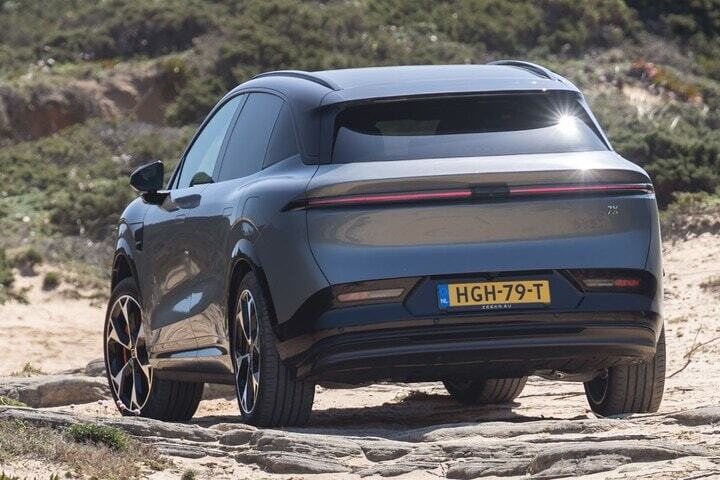
The price-quality ratio of Chinese cars is often surprising, but the Zeekr 7X is another milestone when you see what you get for just under €63,000.
Before the necessary price reduction, the top model of the Mini Countryman with all the trimmings cost about the same. The Countryman, I have one, is lighter and more efficient. But the 7X Privilege has a 30% larger battery capacity and twice the power. It charges three and a half times faster with 800 volt technology, has at least 100 kilometers more range and much more space. Whatever minor criticisms you might have, it is a breathtakingly mature car for this money. Also because you are painfully wondering what, in addition to this high-quality, attractively priced package, the added value can be of electric premium SUVs up to well over a ton, the actual competitors of the 7X. Take a look at the figures: the top 7X has exactly the same power with 639 hp as the almost twice as expensive electric Porsche Macan Turbo. You know one thing for sure; that this is no coincidence but a subtle signal from a future winner to an impending loser.
The Chinese are demolishing the faltering European EV market with offers you can’t refuse. The competition had no other means of defense than price reductions, the market no other defense than tariff walls. Those are not going to help. Then China will retaliate and, given the dependence on Chinese raw materials and technology, that is not a pleasant thought. So we are going to deal and wheel, the geopolitical playing field is already explosive enough.
Although you cannot yet fill the canals with Chinese cars in this country, the Western car industry is already against the wall. I have already written about the rapid and technically superior Chinese hijacking of the electric B-segment. With the BYD Dolphin Surf and Nio’s Firefly, a generation of budget hatchbacks is emerging that has the potential to demolish the entire C-segment. Those two beat everything from Stellantis in this class, while the VW small cars ID1 and ID2 are still a long time coming. China is now putting full pressure on prices in all current segments, even on the top segment by offering high-quality high-tech in the higher middle class for half of what Porsche can still ask for a top Macan. It is a matter of time before consumers draw their sober conclusions. The fact that VW is now selling an amazingly mature ID3 for less than 30k or Stellantis is entering into a joint venture with Leapmotor out of pure necessity says a lot to everything about the relentlessness of a battle that is already forcing unprecedented flexibility on the sales side. This is much more due to the Chinese sword of Damocles than to the faltering plug-in market. List prices no longer say much on the market. The real price war is taking place behind the gleaming facades of the dealers, where the seller is happy to reveal for what bargain price you can take his stock cars with you, if you just bite on the spot, for God’s sake.
The Chinese market offensive gives the impression of a meticulously prepared attack plan. It is now happening so quickly that the fossil competition does not have time to react adequately. In my crystal ball, I see long-term responses to this process resulting in scenarios that now seem too absurd for words. I see Geely slowly dismantling Volvo’s status in favor of Zeekr and Polestar. I see the sinking Stellantis falling and VW merging with Tesla after all, or Mercedes with BMW. Porsche disappears, no right to exist without sound. And no car manufacturer will escape dependence on China. Survivor pragmatism is gaining ground: If you can’t beat them, join them. Toyota is already working together with BYD. Mazda has actually already thrown in the towel with the semi-Chinese 6th. We don’t even know half how afraid we should be of China, and how unrecognizable the car landscape will change in the coming ten years.