Self-driving vans
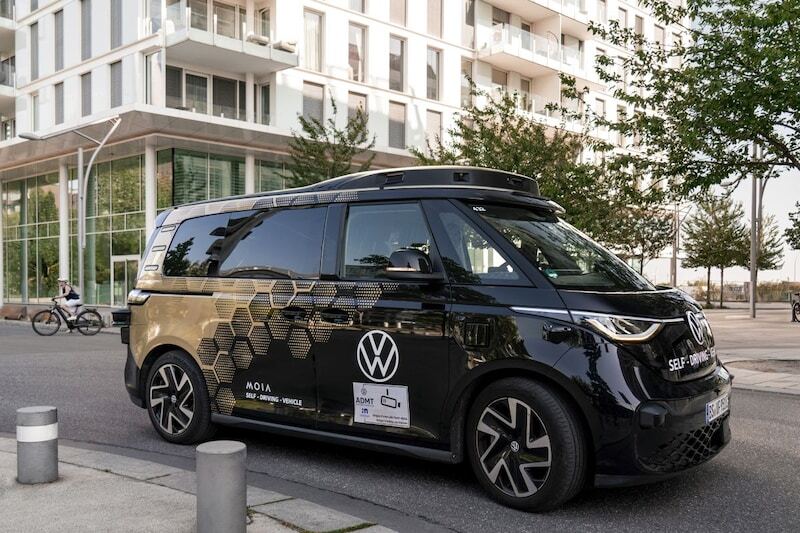
Europe’s largest car manufacturer’s plan sounds ambitious: to have self-driving vans driving through European city centers on a large scale within two years. Will Volkswagen indeed become a serious competitor to public transport?
Christian Senger is a tough nut. That has to be, because he was removed from Volkswagen’s board of directors a few years ago after the debacle with dramatically malfunctioning software in the first electric ID models. Senger was banished to the Siberia of Volkswagen and was put in charge of the self-driving car department: a project that seemed to be on its last legs at the time.
The former technical engineer has therefore been given quite a few headache dossiers since he took over. Not only did he have to integrate hardware (vans) with software (self-driving operating systems). He also had to convince legislators, capitals and sometimes entire governments that it really is possible to make cars drive better than people. Even in extremely complex city centers, such as Hamburg.
But Senger found his way up. Today he shines as CEO of Volkswagen Autonomous Mobility. With the associated subsidiary Moia, he seems to be achieving his goal of having completely autonomously driving vans driving through European city centers on a large scale within two years.
Dead and buried
That is surprising, because a year or three ago the self-driving car seemed dead and buried. The so-called robotaxis from Google company Waymo and GM company Cruise got stuck every now and then in the US, blocked access for emergency services, kept entire neighborhoods awake with their beeping or stopped en masse when the 5G network was overloaded. That, in combination with the consequences of the corona crisis, meant, among other things, that car manufacturer General Motors stopped subsidiary Cruise completely two years ago.
Safety risks, operational problems and a lack of public confidence were the cause of this. The problems included collisions with pedestrians and emergency services, but also concerns about the intellectual capacity of the vehicles to handle certain situations, such as recognizing children. The then state of technology simply made it impossible to let computers think and react like people and so the self-driving car seemed on its way to the scrap heap.
AI turns out to be a game changer
But then came AI. Artificial intelligence also turned out to be a game changer here. Waymo persevered and eventually won the trust, so that today you can be transported through a driving robot in American cities such as Los Angeles, Las Vegas and San Francisco virtually without any problems.
Tesla also continued to believe in the self-driving car, with the result that Elon Musk’s brand is now experimenting with virtually production-ready robotaxis that can move autonomously.
Europe is behind
In Europe, meanwhile, no manufacturer seemed to be found who wanted to venture into this headache file. Throughout Europe? No, because Volkswagen was secretly working behind the scenes on a fully self-driving ID Buzz. That happened with Moia: say the Waymo of the Volkswagen Group.
“The result of the breach of trust of a few years ago is that we in Europe are now two years behind the US,” says Senger. “But we are doing it right in one go now. So don’t hang electric Jaguars or Volvos with cameras and radars afterwards, but ensure ‘ex works’ that all systems are integrated.”
The electric ID Buzz from Moia therefore rolls off the production line at Volkswagen as a ready-made autonomous car. With lidar on board: a laser-guided radar that sees everything in the area, weather or not.
Musk does it without lidar
Elon Musk is also working hard on a self-driving car, but it does it without lidar. Musk calls it superfluous technology, making Tesla a lot cheaper.
“In a sunny state like California you might be able to do without lidar,” says Senger. “But we have to be prepared for everything: fog, rain, hail, snow and then you can’t do without it. All our sensors are also equipped with cleaners that can clean the surfaces with air and water pressure if necessary.”
Check in with your phone
Senger invites us to drive a prototype in Hamburg. For safety’s sake, there is a driver on board who can intervene. The system works as follows: you choose your destination via an app, the ID Buzz AD (Autonomous Drive) comes to you and automatically opens the side door. You check in with your smartphone or a code, after which the ride begins.
For a good half hour, the car drives completely independently through the busy German port city. It smoothly changes lanes, passes cyclists at a safe distance and stops automatically at red lights. In addition to nine lidars, the Volkswagen also has thirteen cameras, five radars and 27 sensors on board that monitor everything in the area 360 degrees.
His computers are fed by real-time data from other Volkswagens in the city. All this means that the driver behind the wheel does not have to intervene once.
There is room for four passengers in the shuttle, who are easy to monitor via an interior camera thanks to striking yellow seat belts. This way the system immediately sees whether everyone is safely fastened.
Combine rides
Because no driver is needed and the cars can be on the road 24 hours a day, the cost price per kilometer is reduced to a minimum. Robotaxis can become so cheap that they pose a serious threat to established public transport companies. Because they also transport you from door to door and do not drop you off at a stop.
You can order the ID.Buzz for yourself, but also as a combined ride. Then the ride price will of course be cheaper. “You can imagine that as a woman you would like to sit alone in the taxi at 03:00,” says Senger. “That is possible, but it is more expensive.”
China is also participating
In any case, Volkswagen sees a lot of potential in the market for self-driving taxis. Where it is still small now, a turnover of 350 to 450 billion euros is expected for 2035 in Europe and the US together. Major competitors are aforementioned companies such as Waymo and Tesla in American cities and Baidu in China.
Moia thinks that self-driving taxis are not only interesting for city centers, but also for suburbs and even the countryside. Public transport companies have withdrawn from there in recent years, because traditional bus transport is hardly profitable due to the low demand.
Moia recently concluded a framework agreement with Uber for a maximum of 10,000 vehicles in Los Angeles. In addition, negotiations are underway with the municipal authorities of Berlin for services in the German capital and the Dutch Volkswagen importer Pon is very interested in bringing the self-driving electric Volkswagens to Amsterdam. The future of autonomous driving seems closer than ever.