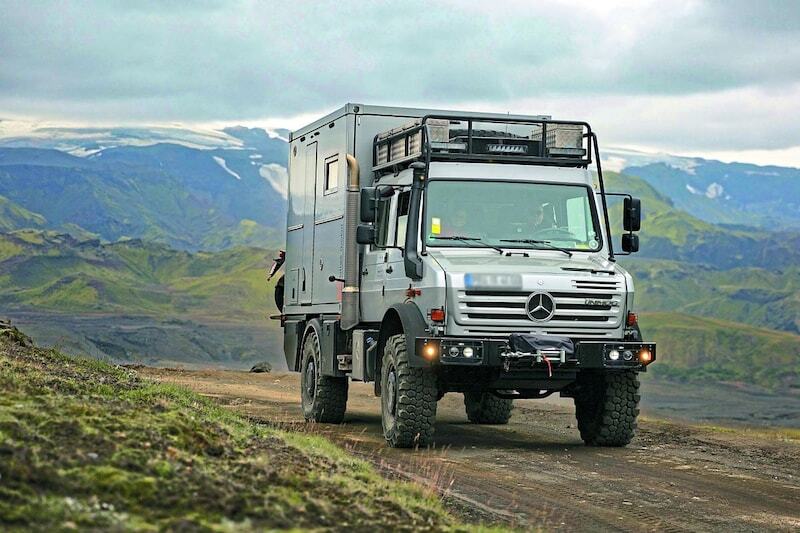
For true globetrotters, the Dutch company Bliss Mobil makes detachable living containers for mounting on the back of a pickup or truck. The units must meet the most stringent requirements, as buyers usually want to leave the beaten path. Feel free to call them rather extreme campers for adventurers!
What do you do when you’ve just sold your software company for a nice amount? Indeed, travel the world, preferably in an expedition vehicle that can take you anywhere. It’s quite a challenge to find the vehicle of your dreams in the range of regular camper manufacturers, one that truly meets all your requirements. Marleen Hoex couldn’t find what she was looking for, so in 2012, together with her husband in Breda, she founded Bliss Mobil BV, a company that builds expedition living containers for mounting on the back of trucks and pickups. Her team spent the first year and a half developing and optimizing the living unit; the first example was a box with a length of 6.10 meters, intended for placement on the back of a Mercedes-Benz Zetros. Such a living container must of course be extremely stable and durable, but not too heavy, due to the load capacity and off-road capabilities of the base vehicle. The box must not only be resistant to extreme weather conditions (-49 degrees Celsius!), but also offer a lot of practical convenience.
Floor heating, air conditioning in containers
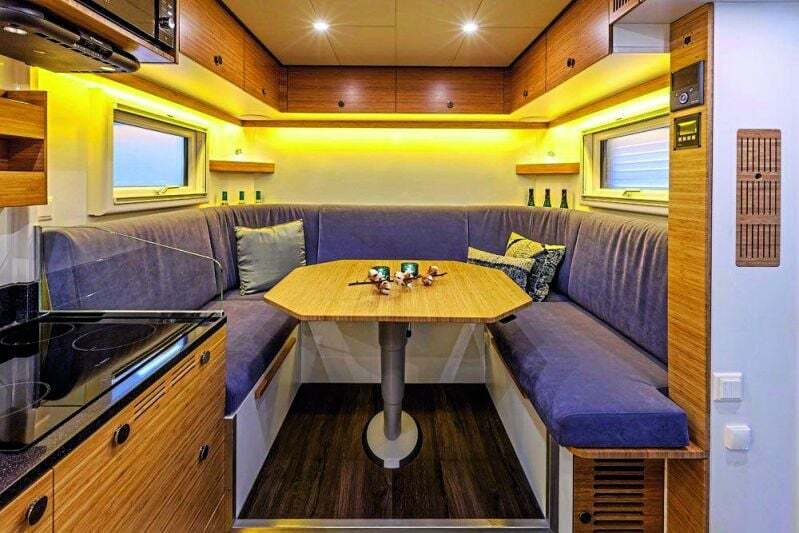
In addition to an extensive, purely functional equipment, there are also things on board that take comfort to a higher level, such as underfloor heating and air conditioning. In short, quite a few demands are placed on a Bliss Mobil living container. Marleen Hoex and her team do not want to build complete expedition vehicles; the company focuses on containers that are suitable for adventure and that can be quickly coupled to a chassis. This requires, among other things, that the boxes can be shipped worldwide, even without a vehicle, and can be assembled and disassembled in about 45 minutes. The living unit is connected to the vehicle via a so-called NATO connector. A nice side effect of this is that the living container can easily be moved from one base vehicle to another.
Find a truck yourself!
Since 2013, Bliss Mobil has only been building living cabins; customers must purchase the vehicle on which the container is mounted themselves. “We can help with the search for a suitable, used truck and we are happy to advise customers on the configuration of a new one if desired,” says Marijn van de Nobelen, sales advisor at Bliss Mobil. Usually the desired vehicle is chosen first, because the length of the cabin depends on the load capacity and wheelbase of the base vehicle. Then we look at what customers exactly want to do with the vehicle and what kind of rides they have in mind. Many Bliss Mobil customers sell their company or their house to travel the world. “That is exactly what our modules were developed for,” says Marijn van de Nobelen. Onboard functions can be operated per app and you can add extras such as bicycle or motorcycle attachments.
Bliss Mobil is particularly proud of the electronics it supplies. The entire cabin, including all electrical components, can be operated from the inside via a module or from the outside via an app. The heating is switched on via a sensor in extremely cold weather and serves as frost protection for the pipes. The rubber seals of the access door or side hatches are also heated, as are the locks. Depending on the equipment, you can equalize the lying surface – ideal when the ground is not flat. The water purifier has a double filter, which converts rain or river water into drinking water, so that you are self-sufficient in this area if necessary. The entire power supply is possibly powered by solar energy – nice when staying in the wilderness. Many parts and materials come from yacht building, because they are said to be more durable and reliable than regular camping materials. Each part is labeled with a QR code, so you can easily order spare parts via an app.
Standardization
The applied standardization is particularly useful for Bliss Mobil. Instead of building highly individualized vehicles, as is usual with expedition trucks, the Dutch company offers a choice of seven body lengths from 8 to 23 feet (2.44 to 7.01 meters) and pre-defined layouts, in combination with mass-produced parts. That doesn’t mean that the special living cabins are cheap, of course. The smallest version costs €120,000, while the 13-foot cabin will set you back at least €220,000 euros.
Mercedes Actros, MAN TGM
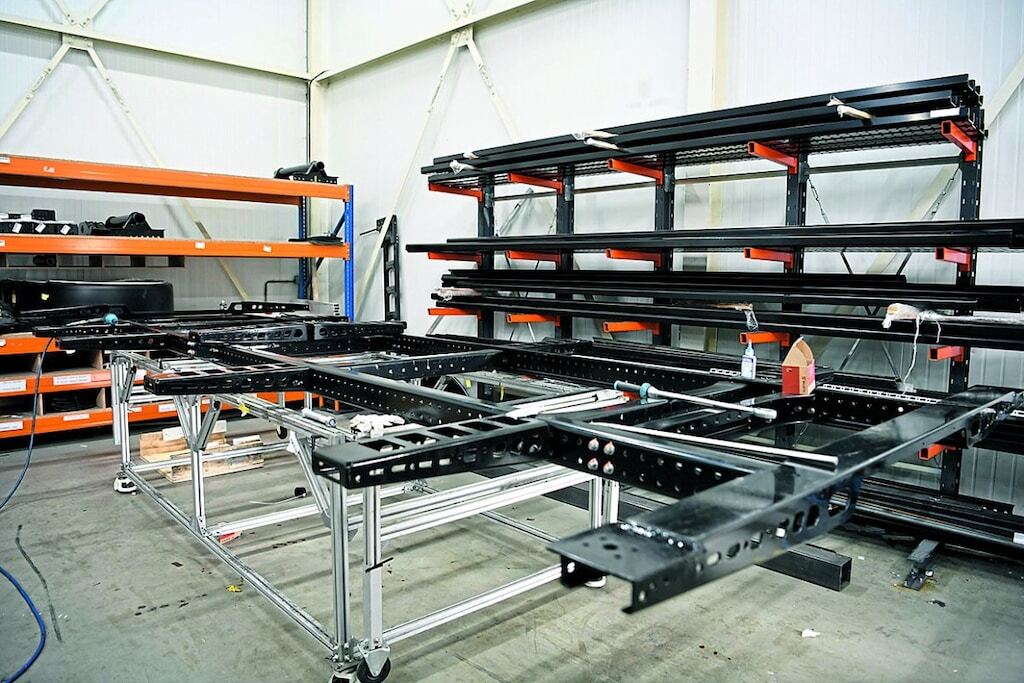
The longest version is available from €400,000. The 20-foot cabin fits on almost all 6×6 chassis, such as those of the Mercedes-Benz Actros and Zetros and the MAN Kat and TGM. It offers enough space for four to eight people, depending on the layout. Customers often opt for the almost four meter long 13-foot version, which is available with four different layouts. Bliss Mobil has already built about a hundred of them in recent years. Three employees need between six and eight weeks to build a container, depending on its size and complexity. The furniture is made in the company’s own carpentry workshop, the steel or aluminum frame is welded together on site by employees and the frame is filled with 60 millimeter thick GFK panels. Then the corners are neatly filled and the cabin is sprayed in the desired color.
Foldable carbon fiber bed
As soon as the cabin is back from the painter, the employees furnish the interior. After installing the electrical components, the heating and the sanitary facilities, the furniture follows. Because Bliss Mobil makes a lot itself (including even the fresh and waste water tanks) and because of the high degree of standardization of the containers, the production process is relatively smooth, with a high level of quality. Bliss Mobil has worked for almost four years on the development of the new compact 8-foot cabin. Especially the complex lift construction presented the employees of the company with major challenges in this most compact unit. With the foldable carbon fiber bed, the integrated toilet and the shower, the compact living container provides more than just the basic needs in the field of camping, despite a length of only 2.44 meters. This cabin also has a fresh water tank, underfloor heating, a water purification system and 600-Ah batteries. This gives them a similar level of comfort to the larger living containers.
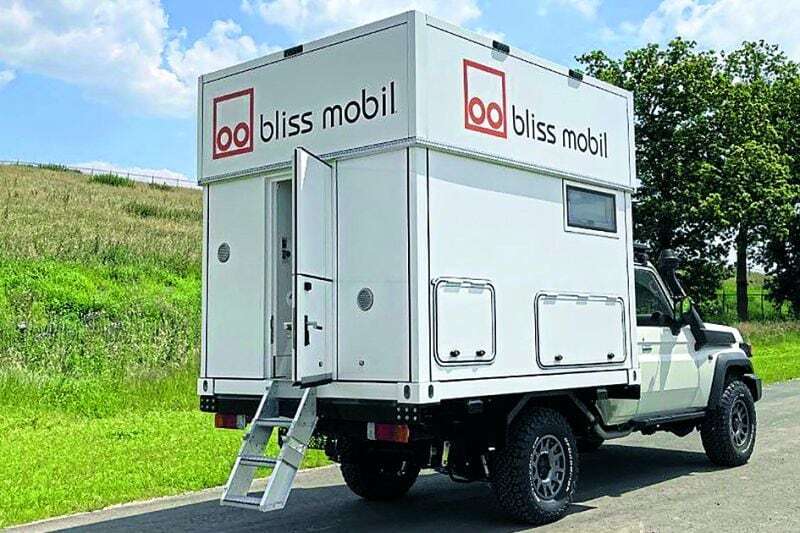
The cabin for two people weighs about 900 kilos and fits perfectly on pickups in the segment up to 3.5 tons, such as the Dodge RAM, Ford F-150 and Toyota Hilux, while a Unimog with a short wheelbase is also an option. Convenient for customers: the compact living unit can be conveniently and inexpensively transported including the base vehicle in a standard High Cube container.
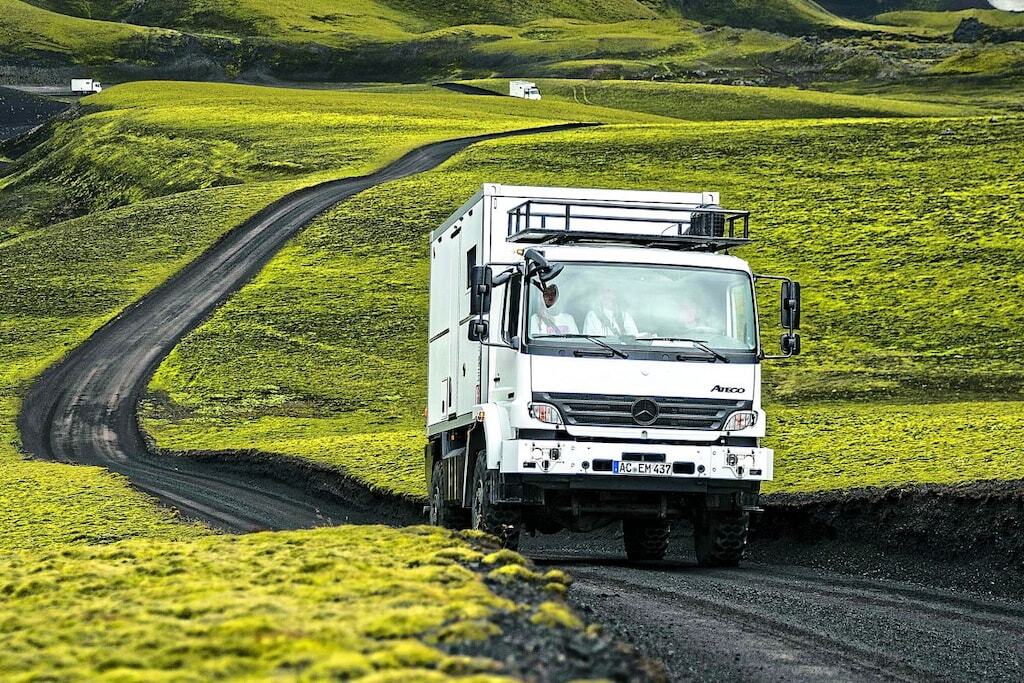
Iceland, Morocco, North Cape or in Namibia
“In recent years, we have received a lot of feedback and suggestions from customers and we have continued to improve our models. Including the version for placement on compact pickups,” explains Marijn van de Nobelen. New ideas are extensively tested before they are realized in small series. Customers receive two days of training during the transfer of their modules, in which they get to know all facets of their new mobile home. Eighty percent of customers travel to Breda to see their living container under construction and take a tour of the company.
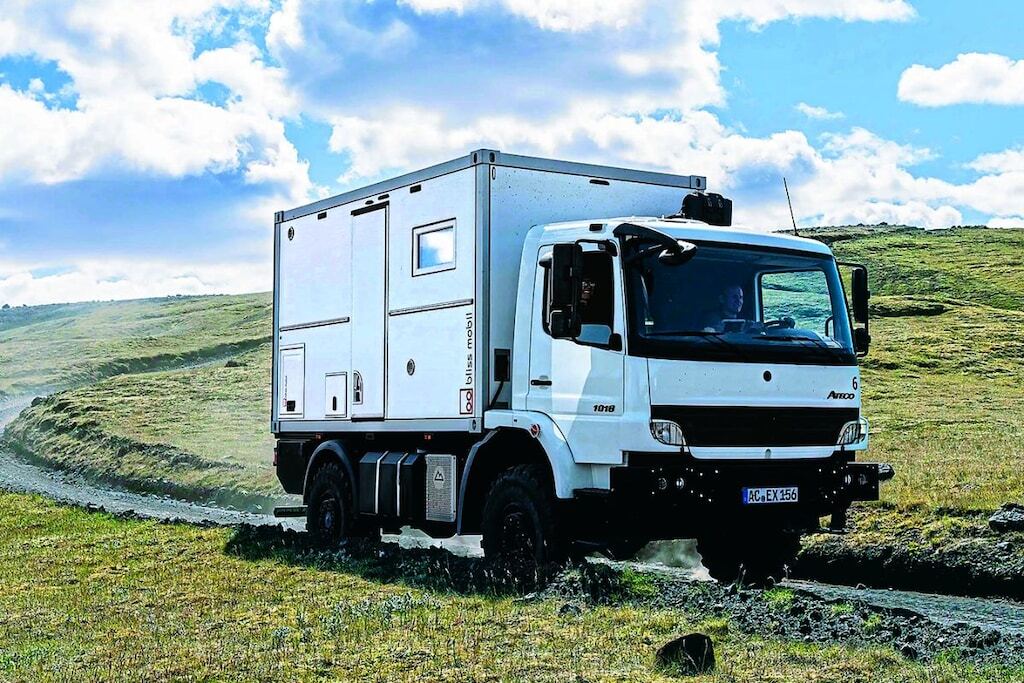
During these tours, buyers learn, if they don’t already know, how to handle their vehicle in extreme terrain, such as you encounter in Iceland, Morocco, on the North Cape or in Namibia. But they can also choose to go on the road under supervision with their four-wheel drive camper first. Renting is also possible, via Overland Travel, which has a fleet of Bliss Mobil vehicles. This year, customers can explore the Moroccan desert or Iceland with the travel organization in a Mercedes Atego with a Bliss Mobil unit. In the future, Bliss Mobil wants to offer a rental fleet on every continent.
“Owners of a Bliss Mobil cabin can discover the world together with us as part of our organized customer trips. However, our main activity remains the production of living cabins for expedition trucks,” says Marijn van de Nobelen. Bliss Mobil is doing well; the company makes forty to fifty living containers per year, while in recent years it has already built more than 250 units. Of these, 30 percent went to Chinese customers. The 45 employees design, build and assemble the boxes. The delivery time is ten to twelve months. They last a long time, according to the manufacturer, who says that the first Bliss Mobil unit from 2013 is still somewhere on the road, albeit not with the founders of the company on board. They chose a different route when, after twelve years, they finally had time for an adventurous ride with their Mercedes-Benz Zetros with a 23-foot cabin: they traveled straight through South America.