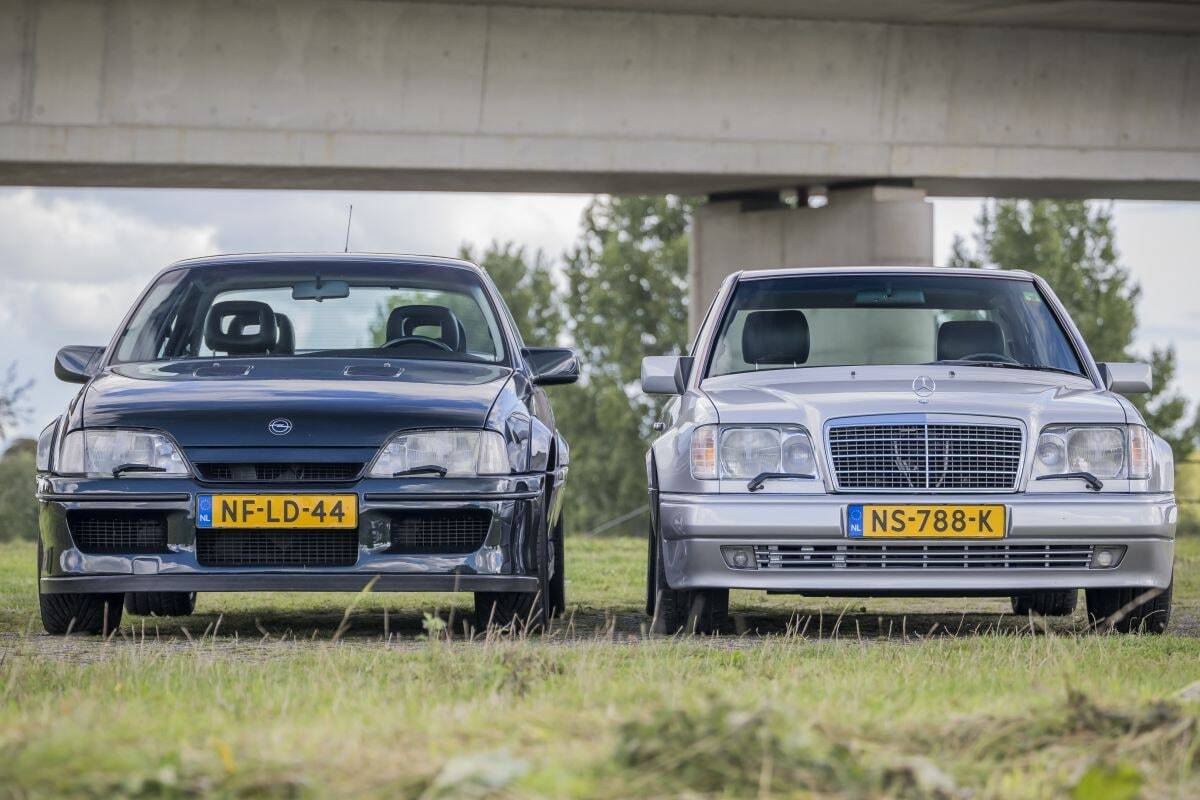
The fact that a Mercedes from the 200-/300-series and an ‘Opel’ Omega could keep up with Porsches and Ferraris some 35 years ago is not pub talk. The 500E and the Lotus Omega were so fast for their time that they still impress today. A duel between an E-class built by Porsche and an Omega assembled by Lotus. How volume models transform into pure thoroughbreds.
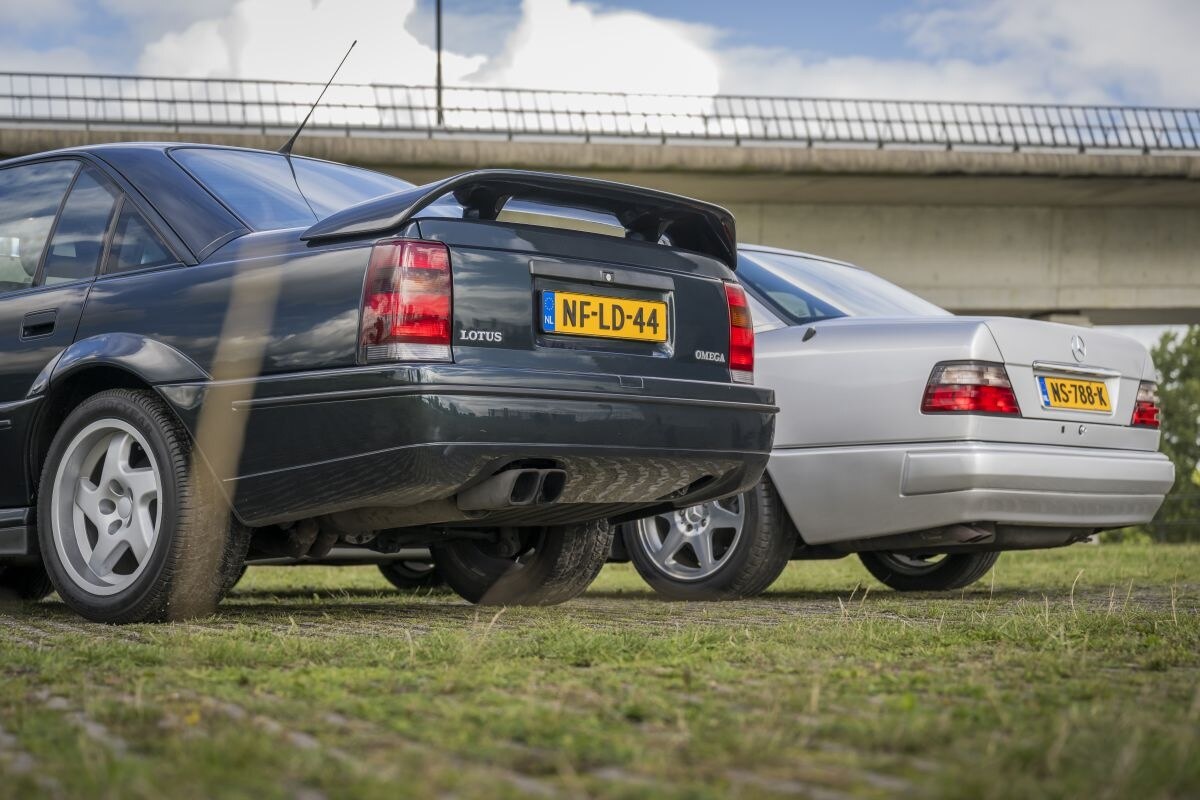
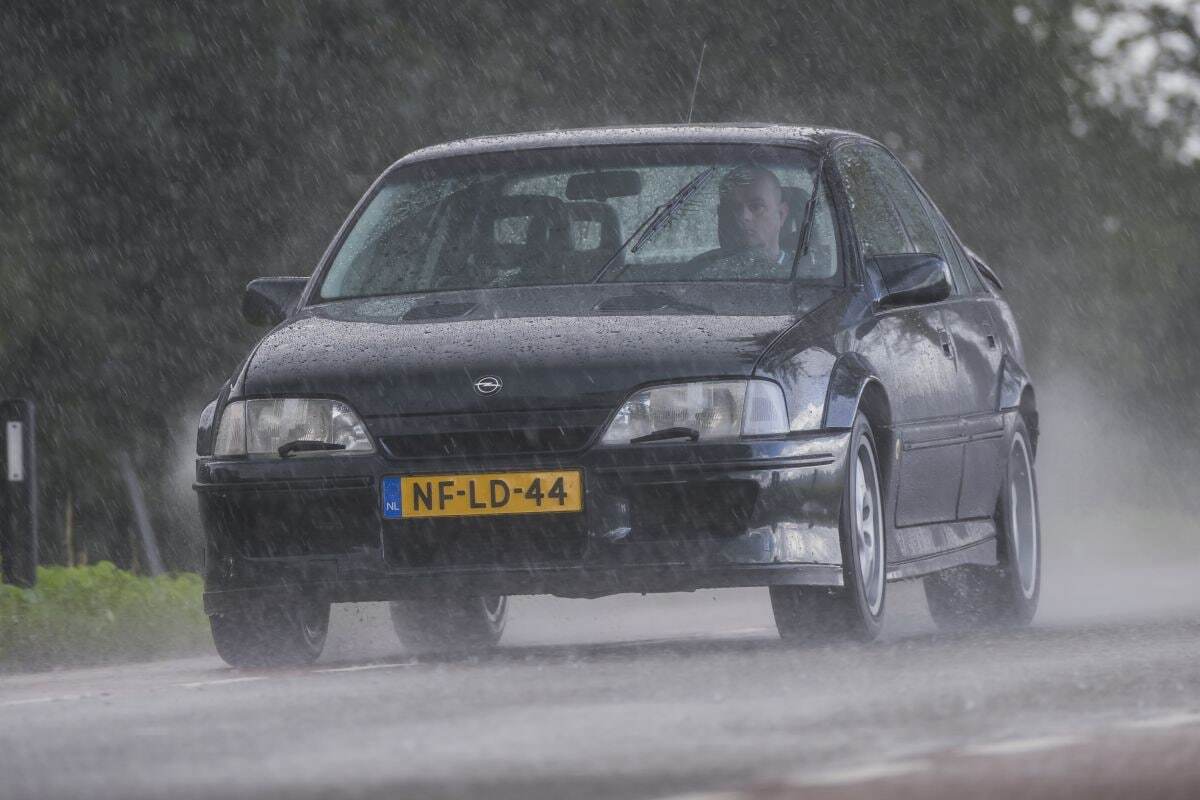
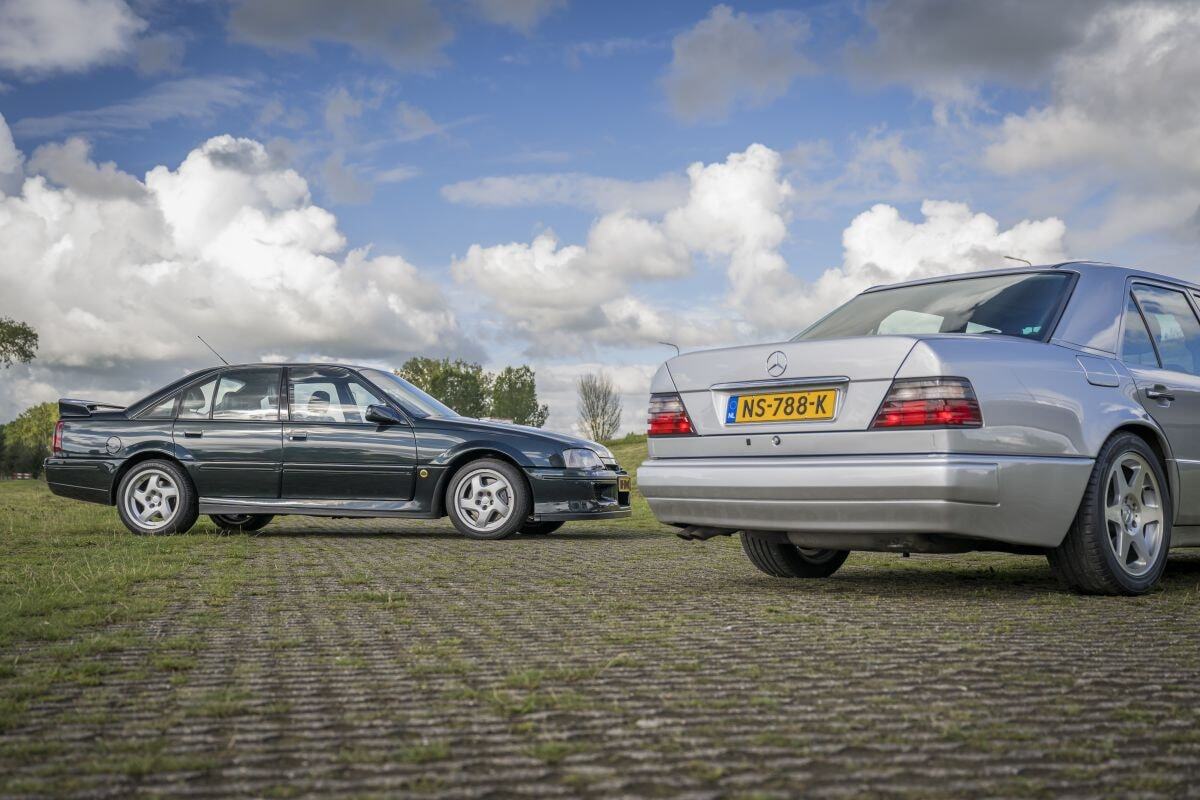
When I park the Lotus Omega next to its opponent after a 40-minute drive over vapor asphalt, I feel a little self-conscious. That feeling is replaced by relief at having safely delivered the 377 hp beast to its destination. Phew, how it spun when I rolled into third gear and accelerated at that green traffic light. Man, what a fierce wagging of the tail when passing that tractor with a load of beets. Constant vigilance, that is priority number one when driving the Lotus Omega. You barely have time to notice glances from bystanders and other road users. But then you get out and you understand that this car simply has to drive the way it does! With its wild spoilers, the Opel Omega, converted into a super sedan, looks like a hooligan from the most fanatical fan section next to a respectable club director, next to the stately Benz. As a Lotus Omega driver, you feel a bit too flamboyantly dressed next to that neat, sleek, subtly muscular Benz.
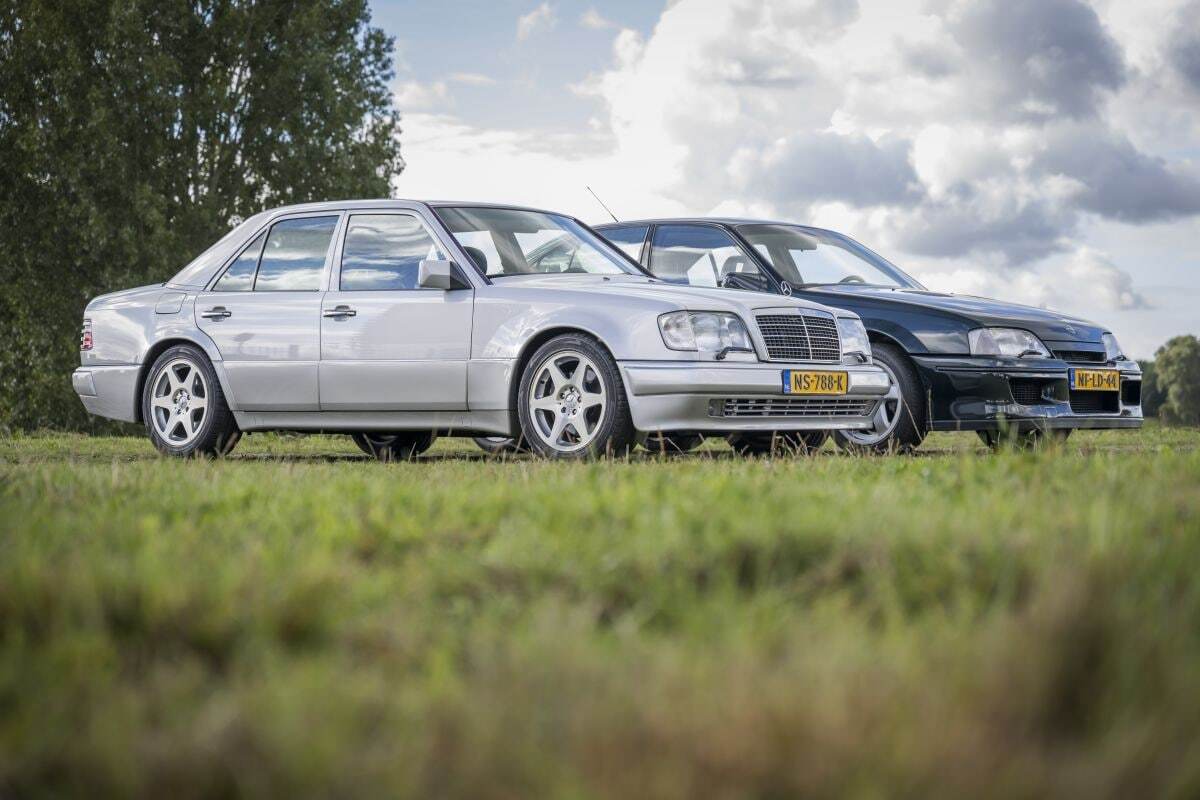
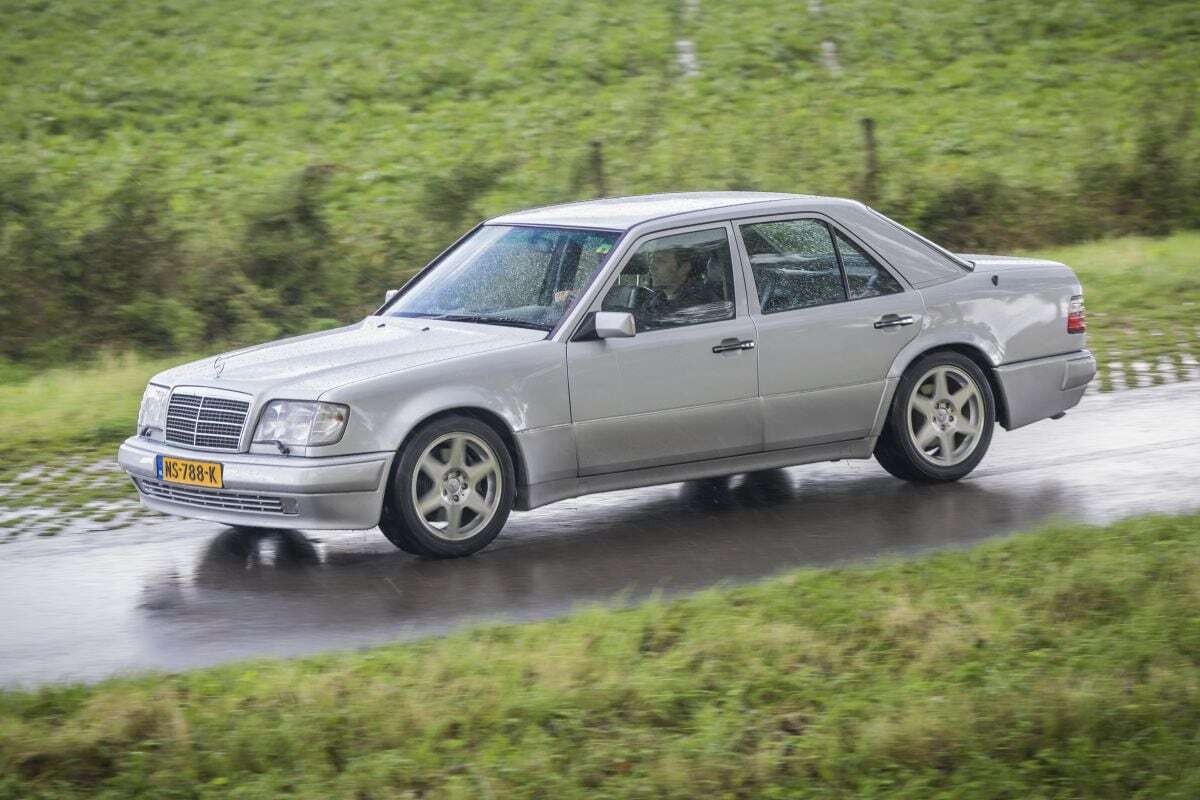
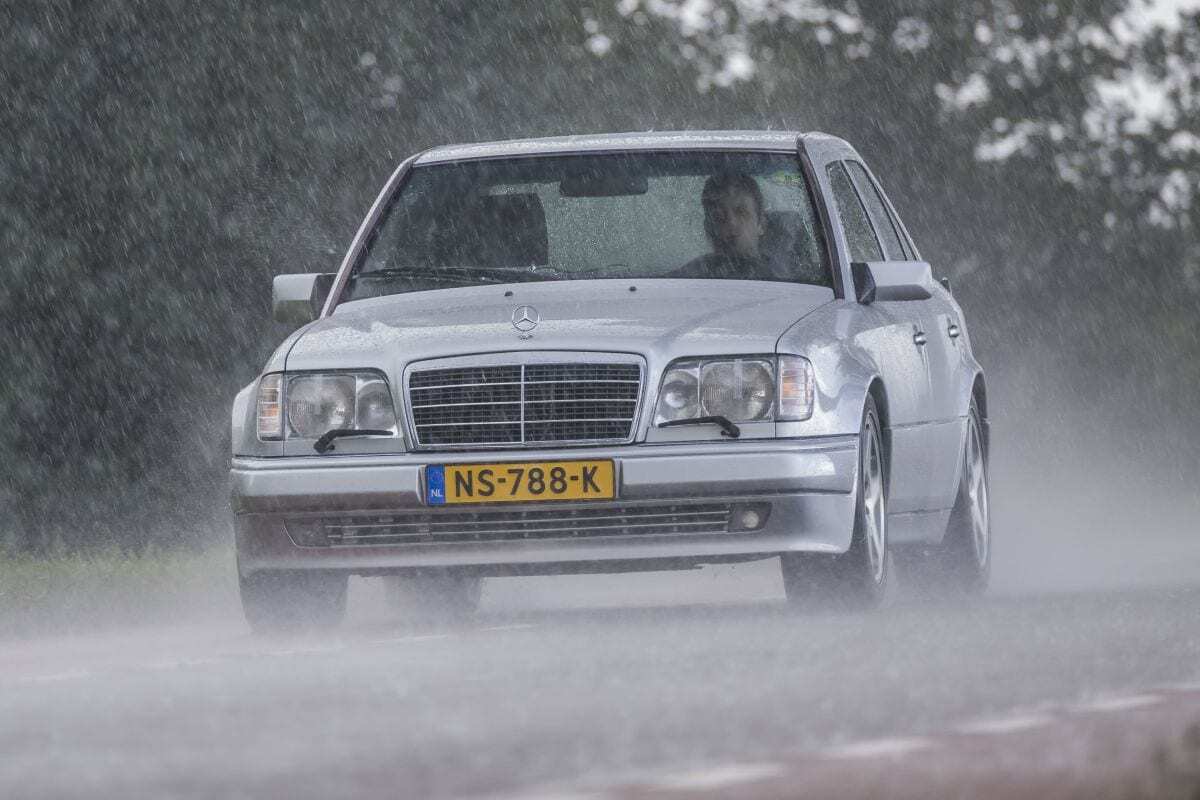
Even as E500 Limited, the muscular Mercedes W124 looks understated
I don’t immediately switch to one of the most fantastic highlights from Stuttgart’s history books, so I can recover from the exhilarating Omega experience but also let the appearance of the über-taxi sink in. That simply takes some time, because even as a Limited, the Mercedes E500 still looks understated. The E before the number 500 means we are dealing with an example from after the 1993 facelift, when the W124 was renamed E-class. Until then, this top version was called 500E.
Engine from the SL
Limited means it is one of the 500 last produced, extra-equipped versions of the muscular W124. This legendary sedan from the early 90s eschews ostentatious exterior display. This is in contrast to its smaller brother from those years, the car from which it borrows its 17-inch alloy wheels: the Mercedes 190 E 2.5-16 Evolution II. Most striking, and immediately recognizable to the connoisseur, are the flared front wheel arches. The heart transplant of the V8 from the SL demanded it, and it is those different front bumper, modified headlights, and increased track width that make this one of the most subtly adapted powerhouses of all time.
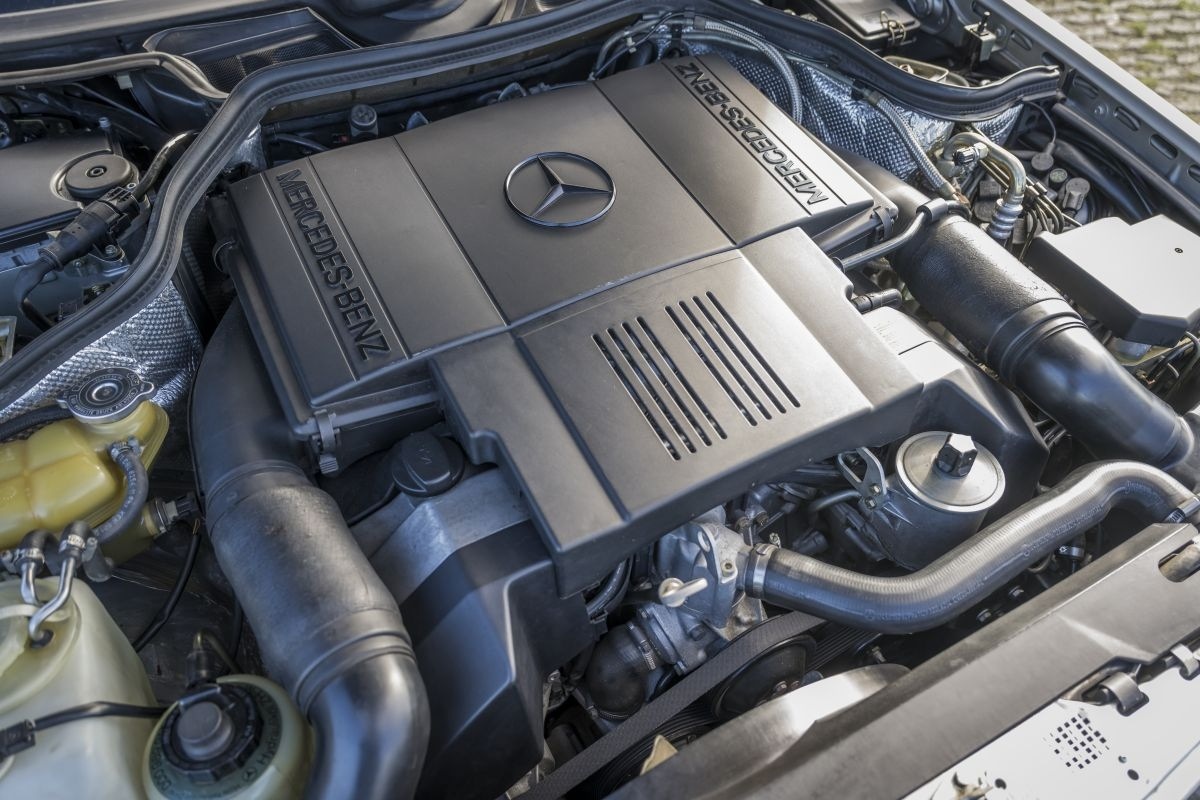
Those front-end modifications were absolutely necessary, if only to adopt the V8 from the SL R129, including the brakes. The car was developed together with Porsche and also hand-built there, which led to a lot of back and forth between Zuffenhausen and Sindelfingen. This was unavoidable due to the maximum development and production capacity reached at Das Haus.
Answer to BMW M5
In the late 1980s, Mercedes-Benz felt there had to be an answer to the BMW M5, but the developers were already very busy with the new SL, and the S-class W140 was also in the pipeline. “Develop a V8 touring sedan based on the W124 limousine with high speed potential that can be built in a small series,” was the directive from Werner Niefer, then head of Mercedes-Benz. The decision to go for the 32-valve five-liter V8 (M119) had far-reaching consequences, as it would not fit into a W124 without costly modifications to the floor, bulkhead, longitudinal members, and wheel arches.
To achieve this, Mercedes enlisted Porsche’s help in late 1987. Porsche had space for assembly. The development center in Weissach was tasked with perfecting the fastest W124. A task the sports car manufacturer gratefully accepted, as things were not going well for their neighbor in Stuttgart at that time.
Omega full or Lotus logos
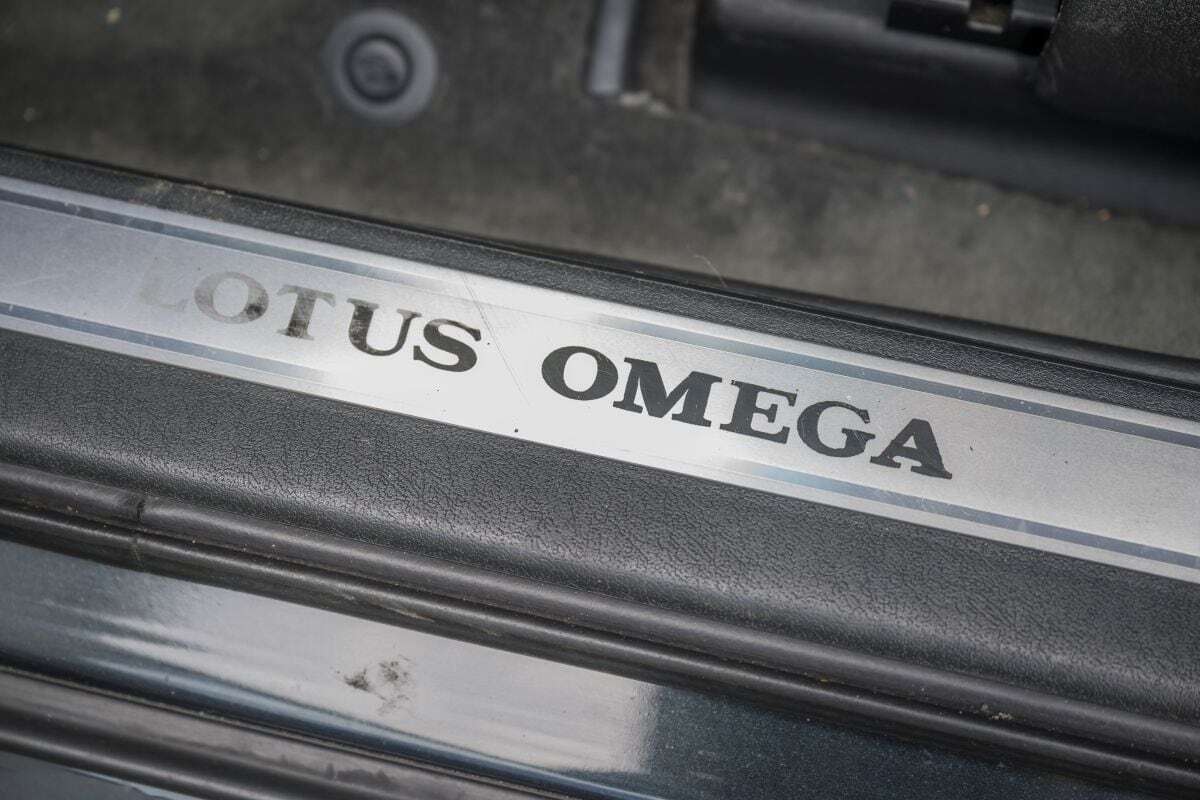
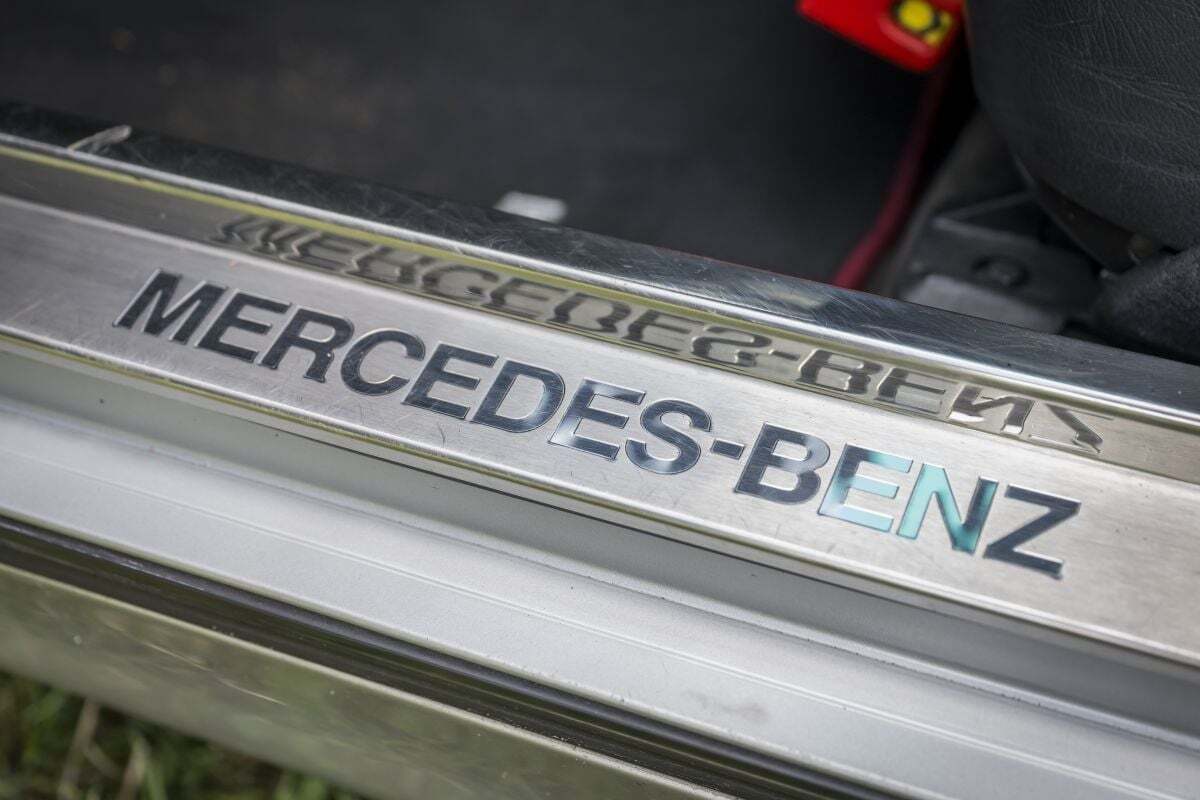
A Mercedes-Benz that originated at Porsche and rolled off the production line there, next to an Opel Omega that Lotus developed and built. But the 500E remained a Mercedes-Benz; there is no reference to the collaboration with the sports car manufacturer. How different it is with the opponent. Only the Opel blitz adorns the nose; otherwise, Lotus logos are liberally sprinkled. Of course, older car connoisseurs still see the Omega A in it, the model that had already outgrown the mid-range, sitting between the Vectra and the Senator in the lineup. Nicely no-nonsense, such a large Opel, with which you showed that you were just a bit more than the average sales representative, without anyone accusing you of being showy.
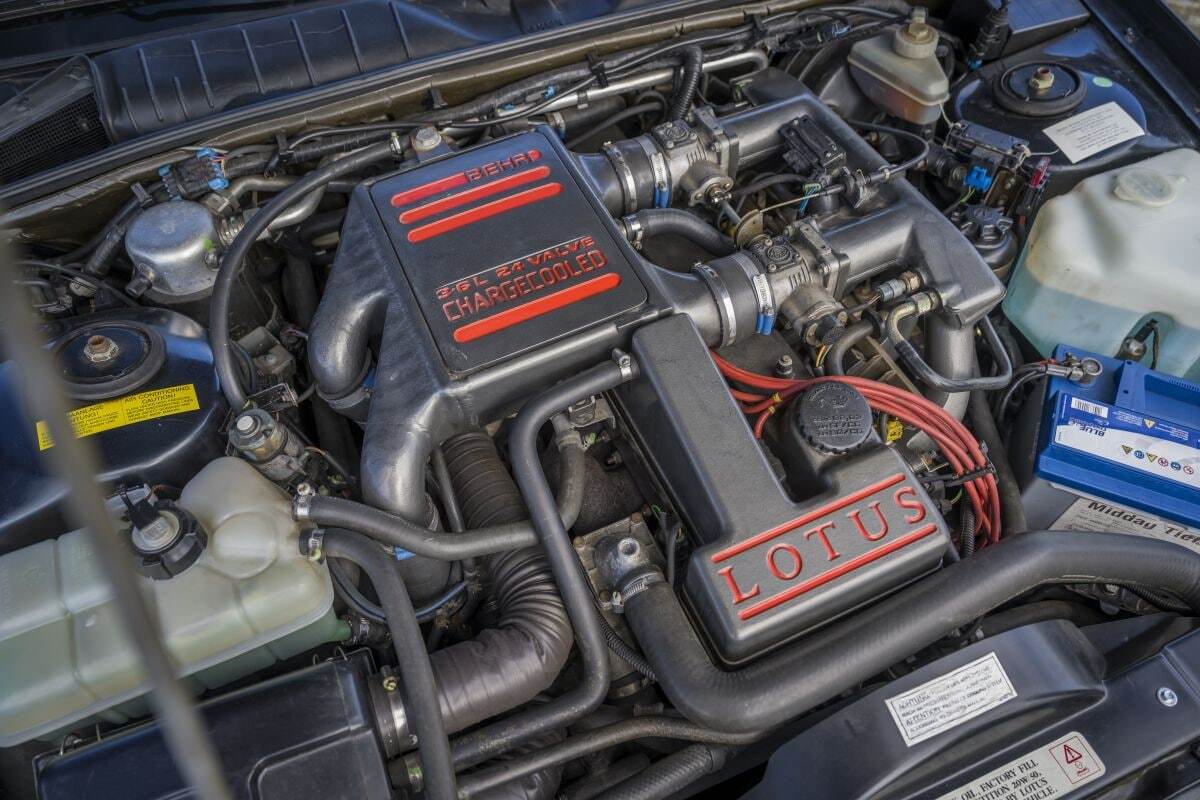
Yet, the GM coalition, formed to create the fastest four-door sedan in the world, had set its sights precisely on this model. The gigantic corporation had acquired Lotus in 1986, the year the Omega succeeded the Rekord. Because a sporty 3000 version of the Omega quickly appeared, with a 3.0 straight-six and two years later even a 24V version with 204 hp, there was an excellent basis for Lotus to repeat the trick it had performed in the 1960s with the Lotus Cortina. That was a Ford, of course, but otherwise, the recipe was very similar to the earlier exercise. Transforming an unremarkable sedan into a supercar in a body you wouldn’t expect to compete with the fastest sports cars of the moment. The 3.6-liter engine with twin turbos was capable of this.
Relics from another era
We are 35 years further. Look at them standing there. The neat silver Mercedes-Benz, without a type designation on the rear, and the wild Lotus Omega. In the current era, even as an Omega 1.8 or E200, they would be relics from the past. The Mercedes-Benz E-class still exists in a modern variant, also as a sedan, but with the BMW 5-series and Audi A6, it is one of the few of its kind. A large Opel four-door has long ceased to exist. The world wants SUVs. Tell non-car connoisseurs that these two sedans are cool Ferraris and Porsches of those days a hard time, and they will look at you blankly. The Lotus Omega sprints from 0 to 100 km/h in 5.4 seconds. As I operate the solidly feeling gear lever of the transmission from the Chevrolet Corvette ZR1, I remember how nice it was for test drivers in those days that you only needed one shift movement for that.
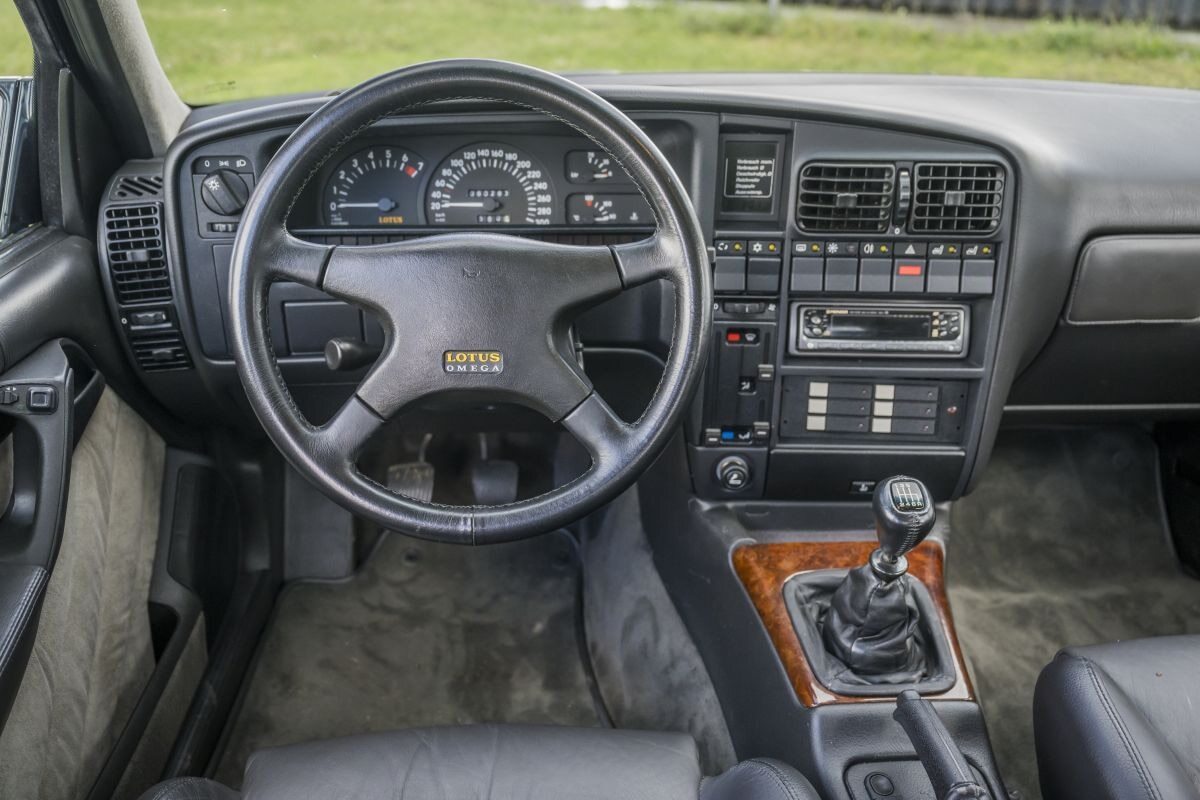
5.4 seconds from 0-100 km/h: Lotus Omega as fast as a Testarossa
The enormously long gears make it possible to reach well over 60 km/h in first gear alone. The famous 5.4-second sprint was seriously fast in those days. Because if you were at the traffic light next to a Ferrari Testarossa, you could study those enormous cooling fins up close for almost six seconds. Seriously, the Ferrari driver really couldn’t outrun that ‘ordinary Opel’ (or Vauxhall, the English version was called Carlton). Just above 100 km/h, the Lotus—you can no longer properly call it an Opel—would give the supercar of the 1980s a hard time.
Lotus Omega had Corvette ZR1 gearbox, Holden Commodore V8 differential
This car is still ridiculously fast in 2024. Above 3,000 rpm, the growing howl turns into a hurricane. On the provincial roads to the photo location where we meet the E500, it’s a constant awareness of a wagging tail. No less than 377 horsepower are sent to the wide rear tires via the differential of a Holden Commodore V8. The 265 millimeter wide rubber has a tough time, and due to the wetness, they even spin in third gear. The strides the Omega makes are impressive. Due to the heavy operation, the six-speed gearbox from the Corvette ZR1 fortunately feels like it can handle the brute force of the 3.6-liter bored-out straight-six. Two turbos are responsible for the gigantic thrust.
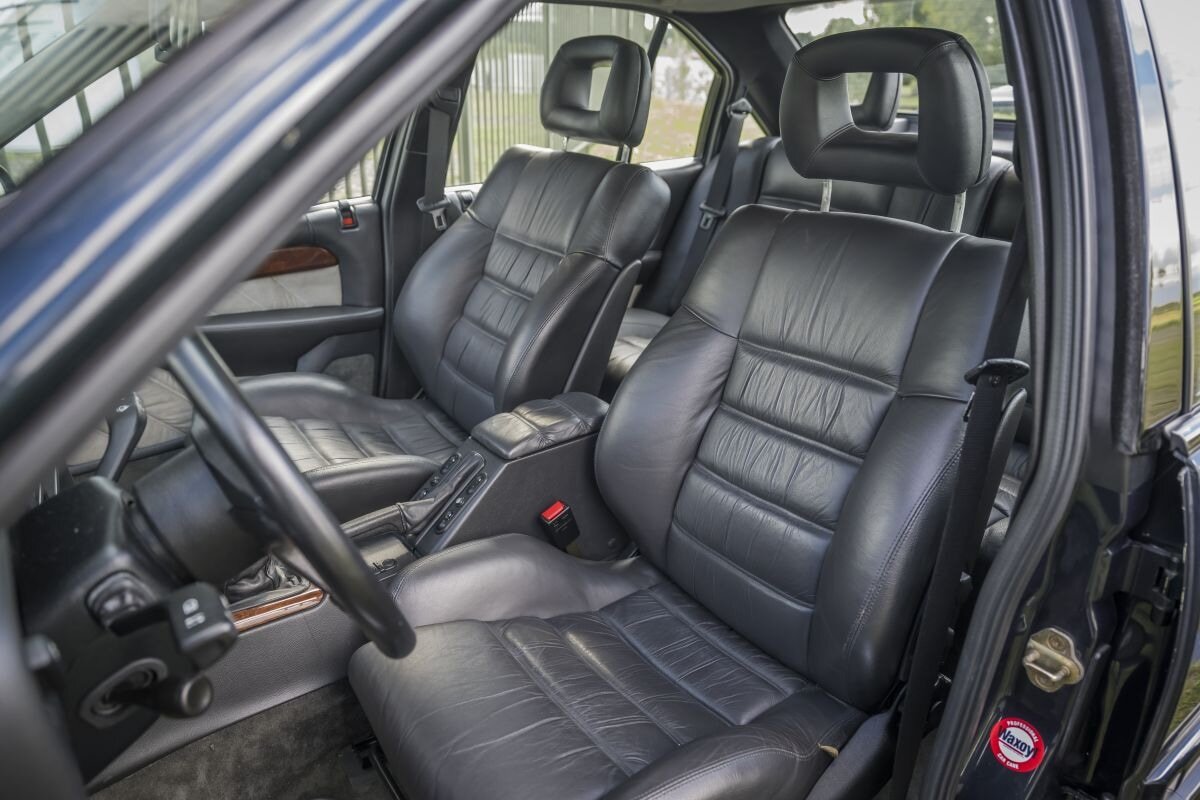
377 hp is insanely much
How insanely much 377 hp is, you realize when you look at the power of the donor car: the Omega 3000 24V had a respectable 204 hp for 1989. That was already enough to give a BMW 535i a hard time. And the M5 of that era? Initially equipped with 315 hp, and from 1992, its naturally aspirated straight-six was bored out to 3.8 liters, increasing power to 340 hp. The Lotus Omega laughed at it. The Mercedes 500E had already made its statement by coming to market with 326 hp. But after 1993, that power decreased slightly, so now we are stepping into an E500 with 320 hp.
Impressed by Mercedes build quality even before starting
Before I turn the key, I am already so deeply impressed by the build quality of this Mercedes that the silky-smooth awakening of the V8 doesn’t even disappoint me after the drive in the Lotus Omega. The Porsche-built Mercedes-Benz looks almost like a modern car under the hood. ‘Under bonnet design’ was probably not yet a term back then, but the E500 is so neatly finished under the hood. Just that little tab that appears in the grille after unlocking via the usual lever in the driver’s footwell. Pull it, and you easily open the enormous hood, which has somewhat more rounded lines next to the grille than the pre-facelift 500E.
Gigantic challenge to get that V8 in
This powerhouse makes the car so special. Because the model series was designed to accommodate a maximum of a six-cylinder inline engine, the Porsche developers hired by Mercedes faced a gigantic challenge. On the one hand, it had to be able to withstand the forces released by the V8 engine and the expected changes in driving characteristics. On the other hand, it needed the necessary space for installation and appendages.
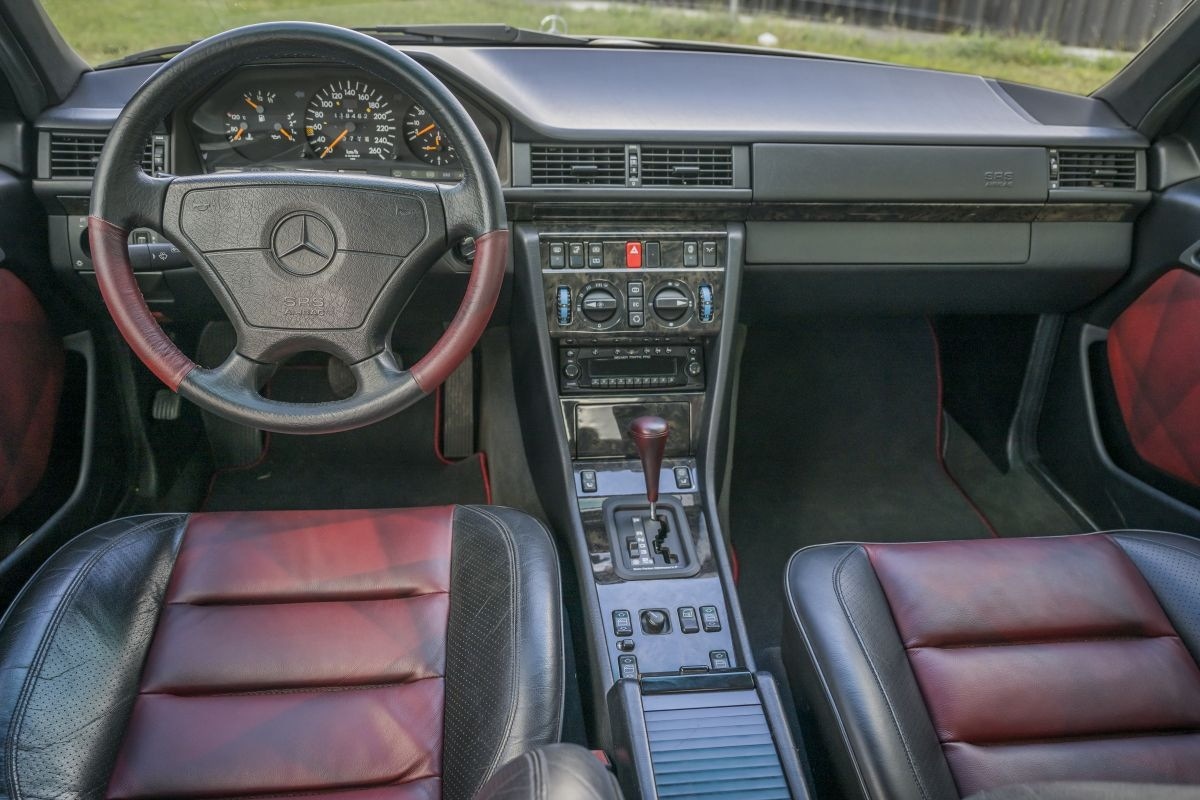
The latter proved to be the biggest challenge. The V8 also required much larger catalytic converters, which were placed on either side of the transmission tunnel. The adoption of the SL’s brakes and the larger engine demanded modifications to the floor section and the bulkhead. And so did other sheet metal parts. The battery had to be relocated, and the car became one of the first in history to get a CAN bus system, a relocation that cost the hefty sum of 5 million Deutschmarks. No expense was spared. And all that, combined with the fantastic interior of the Limited. Mercedes equipped the cockpit with so-called bird’s-eye wood, in combination with every conceivable button. This aspect alone is so overwhelming that the experience of the powertrain almost becomes secondary. Yes, that sounds bizarre, I realize.
The feeling disappears the longer I drive the special Benz. The shifting moments of the four-speed automatic are silky smooth; the enormous flexibility of the 5-liter V8, which rumbles modestly, makes you feel like you’re in a much younger power sedan. This is not a beast, unlike the Lotus Omega, which constantly gives you the idea that you are driving an Opel that has been beaten around a Corvette chassis and powertrain.
Production number and speedometer up to 300 in the Omega
Three years ago, I last sat in a normal Opel Omega, a tame 2.0i like you would see at every roadside restaurant around lunchtime in the late 80s, early 90s. This Lotus variant has the same dashboard, but I’ve never seen it with so many switches. On the glove compartment, there’s a leather overlay with the production number. The layout of the instrument cluster is still the same, but I definitely see ‘300 km/h’ here. Reaching the end of the speedometer, as the E500 should be able to (officially limited to 250 km/h, the speedometer goes up to 260), taking some speedometer deviation into account, might not be possible, but the needle of the Lotus, which the manufacturer claims reaches 283 km/h, should still be able to get close to 300. What a brave heart you must have then! Where the Mercedes-Benz feels perfectly balanced, partly thanks to its self-leveling suspension and ASR, in the Lotus, the fear that it might run away with you constantly looms.
Fortunately, I drove it on dry asphalt a few months earlier, and then it inspired more confidence, and I understood that wicked super sedan. The steering isn’t overflowing with feel, but the car reacts very quickly to input, making the Omega feel somewhat more agile than the 1,710 kg E500. The E500 is stoic; the Lotus roars and snorts, dances and skips. The Mercedes E500 Limited feels exceptionally refined, like a sedan in which you feel the influences of the absolute top cars of that era, the SL and the S-class.
Lotus Omega is a monster
The Lotus Omega is a monster that will keep you awake at night for a long time. It’s almost inconceivable that something like this ever emerged based on something as ordinary as an Opel Omega, while the Mercedes 500E laid the foundation for all subsequent AMG E-classes. The E500 Limited also served as the starting point for the even more exclusive E60 AMG, from the period when tuner AMG had just been incorporated into Das Haus. The Lotus Omega was more a wild eruption of GM and Lotus’s drive to act than a representative of an era; the E500 can be seen as its beginning. An era in which AMG would grow into a counterpart to BMW’s M division.
The passion and love that Mercedes-Benz and Porsche poured into the 500 were reflected in the price; the last new price was €111,000 (fl.245,000), while a similarly motorized SL cost €132,731 (fl.293,000) in those days. Finding a Dutch price for the Lotus Omega is more difficult. Only a few were delivered, and they reportedly went for almost fl.150,000 on the road. This particular example was brought to the Netherlands two years after its initial registration in Germany (DM 125,000).
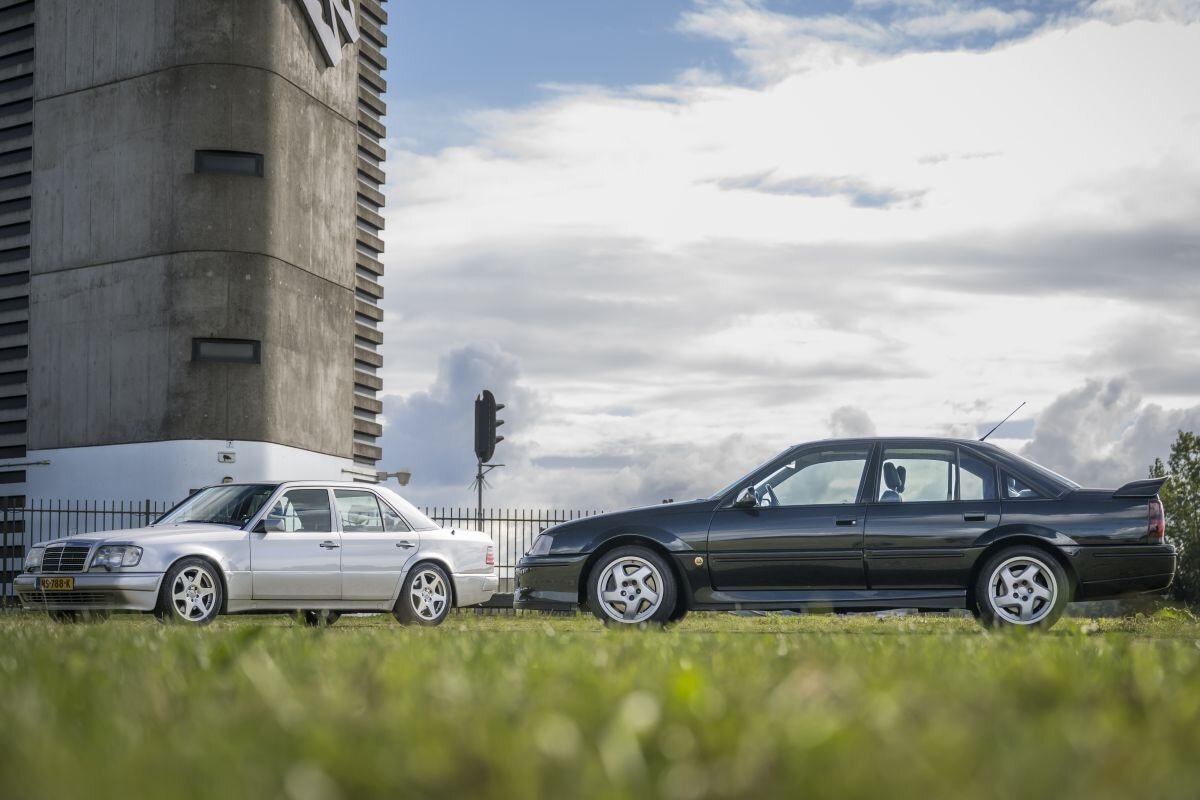
Still, that one and a half tons in guilders is a pittance compared to the price of the Mercedes 500E/E500. Mercedes-Benz got away with it; the 500E became a greater success than expected. Between 1990 and 1995, Porsche built 10,479 units of the 500E, including 951 units of the E500 Limited. Lotus built 907 units of the Omega, instead of the targeted 1,100 units, of which a third were delivered as Omega in Germany, the rest remained in Hethel in the United Kingdom after completion, and were therefore badged as Lotus Carlton. The Omega is more special, feels more special, and above all, captivates you with its character.
The W124 impresses in a completely different way despite the absence of spoilers and wings. Despite its special genesis, it feels like a Mercedes, a masterpiece, while the Lotus is essentially nothing more than an Opel. Only the bodywork and dashboard are typically Opel; everything around and underneath comes from other GM performance brands, and it feels that way too. Even this one example from the series of 500 produced Limiteds, I would confidently use as daily transport; not a hair on my head would consider doing that with the Lotus.