Volvo immediately offers 3 versions
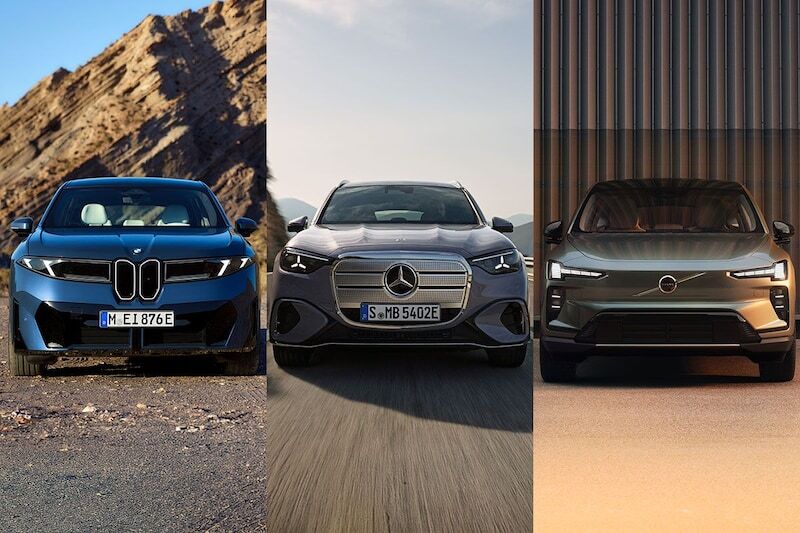
Car manufacturers keep a close eye on each other. This has quickly resulted in three direct rivals from BMW, Mercedes-Benz, and Volvo. We will take a look on paper at how the EX60 stacks up against its German competitors.
For a real comparative test, it is still far too early, so what you see here is pure theory. This theory, however, underlines the point that the BMW iX3, Mercedes-Benz GLC, and Volvo EX60 are direct rivals. The cars are all roughly 4.80 meters long, all fully electric, all exceptionally powerful, and all the latest and best these manufacturers have to offer in terms of electric vehicles.
However, the similarities go even further. All three cars mark the arrival of a new electric platform and are the blueprint for other electric models yet to follow. At BMW and Mercedes, the specifications also seem eerily similar. Both Germans are launched as all-wheel-drive, twin-motor super-EVs with 469 (BMW) or even 489 hp. The batteries in the 50 xDrive and 400 4Matic are around 100 kWh, providing a serious range, with the BMW offering slightly more than the Mercedes. Less powerful versions will come later from these brands, but have already been announced.
Volvo takes a different approach and immediately launches the EX60 as P6, P10, and P12. This means rear-wheel or all-wheel drive, 374 to 680 hp, and batteries of 80, 91, or 112 kWh. A logical consequence is that the Volvo also has a lower starting price, but then we are comparing apples and oranges. For a fair comparison, you will therefore find the very thickest Volvo EX60 P12 version in the table below, which, by the way, has a longer delivery time than the two cheaper variants. The P12, with its specifications, strongly resembles the iX3 and GLC, but has even more power and is therefore even faster. The fast charging peak is a lot lower, but a 10-80 percent time of 19 minutes promises a tight charging curve. The Volvo’s luggage space differs by exactly three liters from the BMW’s, but the Mercedes is clearly the most spacious, both in the front and rear. The Mercedes, with a stated consumption of 14.9 kWh, is also slightly more economical than the already very efficient BMW, although we previously concluded that an expensive option package is needed to achieve that. The Volvo lags a bit in this area, but still scores neatly.
For the most complete overview, we also show the differences between the three EX60 powertrains below. The P6 seems to be the smartest option for most people and is relatively affordable, although for real power and more range, you still have to opt for the more expensive versions.