Expansion
Dacia has had a good year. So good, in fact, that it already dares to look ahead to what it will be up to this year. A lot, because Dacia is introducing no fewer than two new models this year.
The Dacia family, which already consists of the Spring, Sandero, Jogger, Duster, and Bigster, will be expanded with two new models this year. The first is an electric city car, an A-segment model. We were already aware of the arrival of that car. It will be the Dacia derivative of the Renault Twingo, naturally with a completely unique body. It is plausible that this new electric small Dacia will eventually replace the Spring. After all, they fish in the same pond. The second model is a size larger.
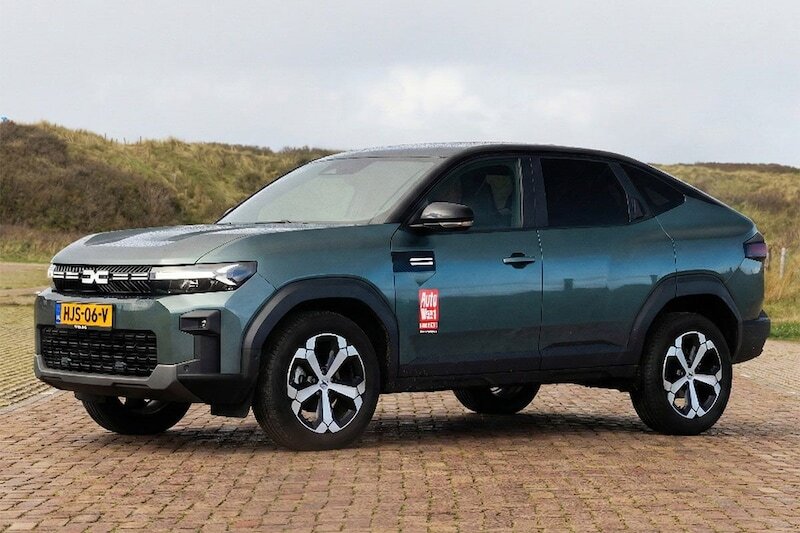
Dacia speaks of the arrival of a new model in the C-segment. So, a compact mid-range car. For clarification: Dacia considers the Duster a compact SUV operating in the B-segment. Its larger brother – the Bigster – is a so-called C-segmenter. Therefore, another model will be added to that class. This will not be an EV but a model with internal combustion engines and hybrid powertrains. We expect Dacia’s new model to share its technology with the Bigster and thus also with the Duster. The form in which Dacia will cast its new model is not yet clear. Don’t be surprised if this is also a model that stands high on its wheels but distinguishes itself from the Bigster with a more sharply sloping roofline. Perhaps a kind of budget-Rafale, although we are now delving very deep into the crystal ball.
Dacia Sales
Last year, Dacia sold almost 700,000 cars in Europe. 697,408 units, to be precise. That was 3.1 percent more than in 2024. These almost 700,000 Dacias bring the total number of cars Dacia has sold since 2004 to over 10 million.
In Europe, Dacia registered 601,765 cars. That was 2.9 percent more than in 2024. Of all cars bought by private individuals in Europe, Dacia had a share of 7.9 percent. That’s considerable.