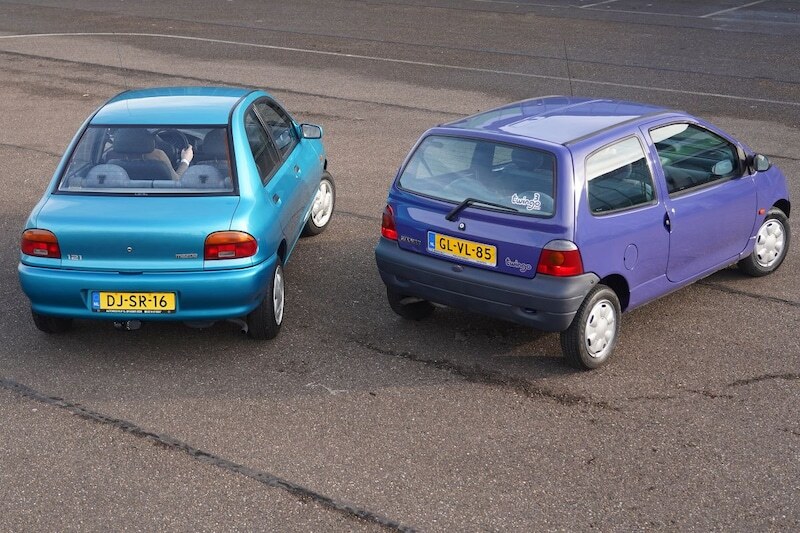
While the Netherlands was extensively building Vinex districts, two remarkable compact cars appeared on the market shortly after each other. The Mazda 121 caused a stir in 1991, and the Renault Twingo followed in its wake. How did they fare?
Blending into the crowd. For some, the ultimate wish; for others, a horror. Gaining attention and being famous is what life is all about for some. In the case of the Renault Twingo and the Mazda 121, this completely holds true. In the early 90s, their controversial appearance garnered praise from every corner. But only a few actually bought the 121. In six years, fewer than ten thousand compatriots signed a purchase agreement. For the Twingo, however, it was a storm: the Netherlands bought almost 80,000 units between 1993 and 2007.
Now there are hardly any A-segmenters left
In the 80s and 90s, it was still worthwhile to develop an A-segment car. It’s no wonder this segment was by far the most popular in our country for decades, where the road tax (mrb) was considered a more severe curse than that other three-letter abbreviation. But small cars are also expensive to develop. In fact: almost as expensive as B-, C-, or D-segment cars. But manufacturers simply cannot sell them for the same price. No wonder many brands are throwing in the towel. Only the Toyota Aygo
How different was the situation with superminis in the 80s and 90s. Do you remember them? The Daihatsu Cuore and Charade? The Peugeot 106? Of the two rivals we present in this twin test, we can only vividly remember the Twingo. We have almost forgotten the Mazda 121. Remarkable, given its outlandish appearance.
121 also as Cabrio Top
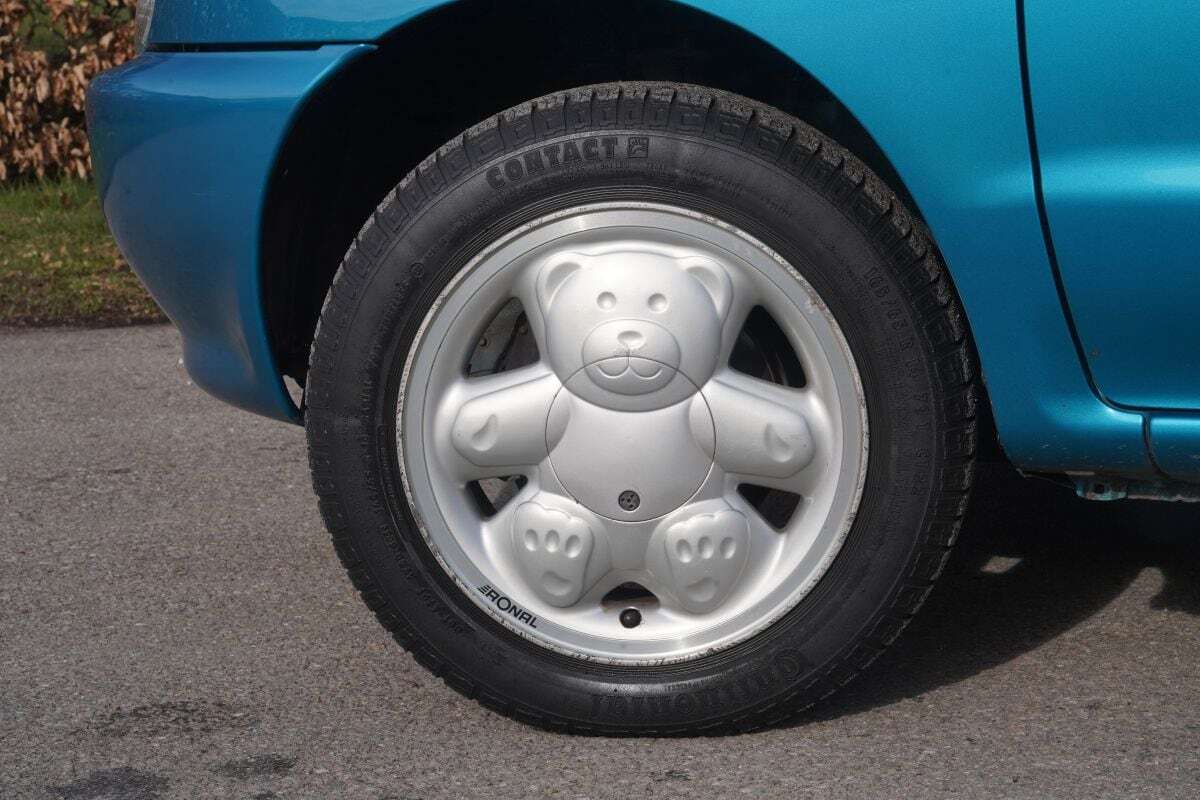
The Mazda 121 caused quite a stir when it made its way to Europe in 1991. For example, my good friend Ron deposited no less than 27,000 guilders into the giro account of the Mazda dealer in Amersfoort. All his savings went to the most luxurious variant of the 121, the 1.3 GLX Cabrio Top. He checked all the extras: the electrically folding roof, metallic paint (mica blue), electrically operated side windows, and central locking. He only found the automatic three-speed gearbox staid and the famous bear-shaped rims childish. So he didn’t take those. Ron was, after all, a 27-year-old bachelor. You don’t make an impression on your first date with that, do you?
Mazda becomes controversial
‘With small cars, you can rarely build an image. Unless the model hits like a bomb.’ With this statement as a guideline, Mazda developed a new controversial model in the late 80s that was supposed to turn the A-segment upside down. Mazda was the eternal third after Toyota and Nissan in Japan and its surroundings. In the mid-80s, it had grand plans, fueled by economic optimism. Mazda made ordinary cars for the masses but stepped out of its comfort zone with rotary-engined sports cars. Until it reconsidered its future in the mid-80s. The average had to end.
Mazda transformed the boring 323 into a dynamic trio, with the elegant five-door F being the highlight. The 626 underwent a transformation that instantly made it the most successful lease car of the early 90s. With Xedos derivatives 6 and 9, the brand wanted to polish its image. Don’t forget the cheerful MX3 and MX6 and, above all, the most popular convertible ever: the MX-5. And at the bottom of the pecking order? There appeared the cheerful 121 in 1991, in contrast to its colorless predecessor that attracted hardly any customers between 1988 and 1991. If the old 121 was a hatchback, the new 121 was an ultra-short four-door sedan.
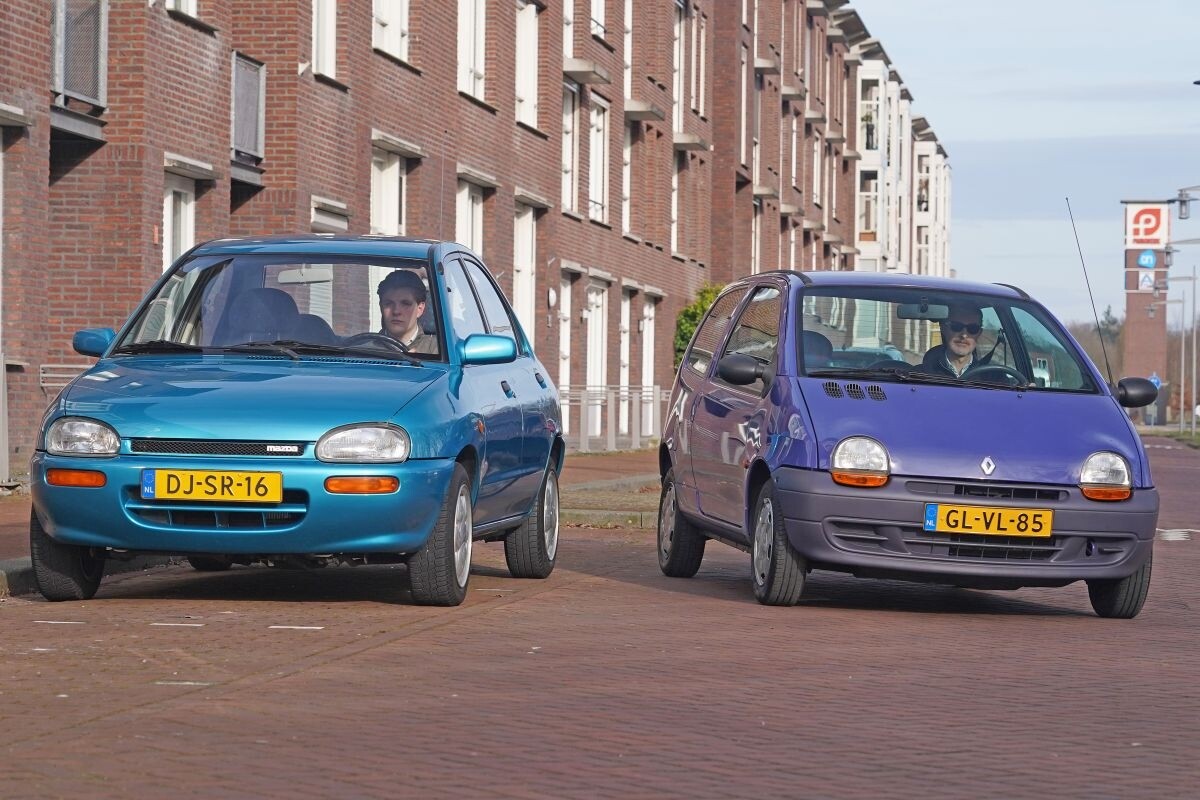
Joyfulness radiates from it
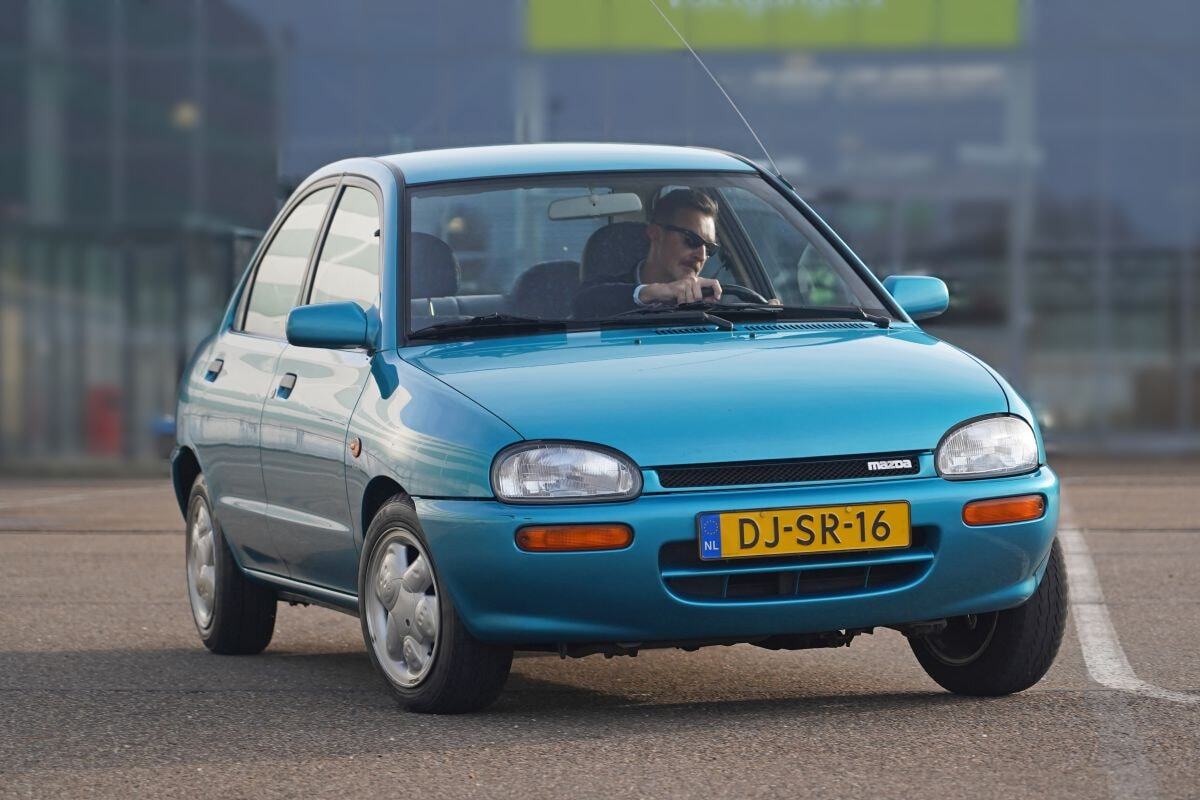
When the 121 made its debut at the Geneva Motor Show in 1991, it received predominantly positive comments. Its squat sedan posture, soft teardrop-shaped exterior with a cheerful round bowler-hat shape, the playful headlights, and the four doors instantly made many competitors look outdated.
Nothing seemed to stand in the way of great success. Long before the Volkswagen Passat B5 made its appearance, this 121 already had the widely copied arched roofline that earned it nicknames like bowler hat, jellybean, and bubble car. The shape was not new to Mazda. If you Google the Mazda Carol 360 from the 60s, you’ll find a surprisingly similar silhouette, although it was intended for the kei-car segment. In the 1989 Carol, we see even more similarities, partly due to the extremely high windshield.
121 quite expensive
Interest in the new 121 was great, but it did not translate into large sales figures. The high expectations were not met, despite the practical four doors and the abundance of headroom. Its exorbitant price was its most serious drawback. Importer Autopalace De Binckhorst saw a glorious future for the idiosyncratic model and attached an ambitious price tag to it. The 121 was available as a basic LX with a 53 hp 1.3, while the GLX was the sixteen-valve variant with 73 hp. In addition, there was the Cabrio Top, essentially a GLX with an electrically operated folding roof. Mazda assumed that the general public wanted something different from yet another gray three-door hatchback and thought that four doors were the future and that a convenient ‘third’ or ‘fifth’ door was not necessary.
Unfortunately, the short boot, in addition to the unfortunate pricing, turned out to be the big spoiler. The public expected a convenient large door in that short rear end, but was disappointed. An inconveniently short boot lid spoiled an otherwise excellent access. Another cause points to conservatism. Malicious tongues claimed that the 121 appeared too early, the market needed time to get used to it. Only 9,300 units were bought by Dutch people between 1991 and 1996.
Renault Twingo sells like hotcakes
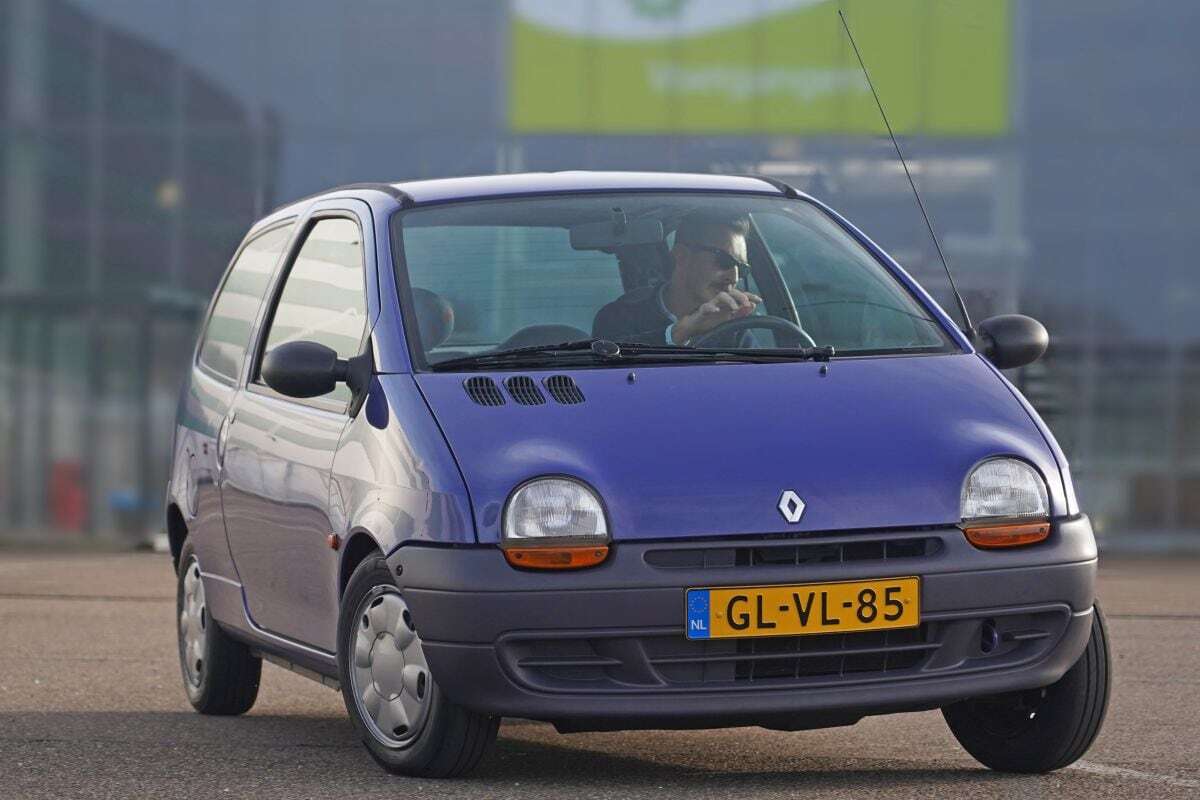
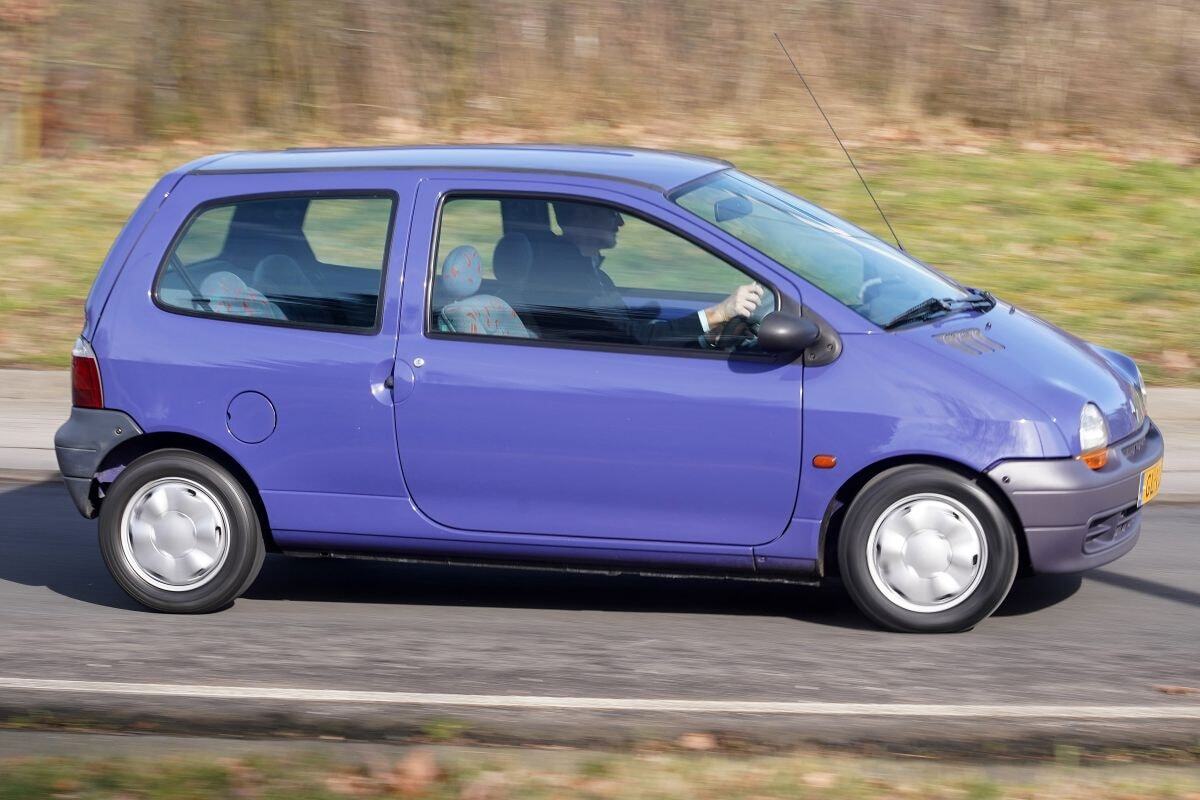
The Renault Twingo sold like hotcakes when it appeared on the scene just two years after the arrival of the 121. Europe massively fell for its playful eyes. The 2.6 million buyers didn’t mind that it was a three-door, while five-door hatchbacks had also started their rise in this class. It’s almost certain that the 1989 Mazda Carol and the 1984 Honda Jazz inspired the Renault design department for the Twingo. The relatively high build within the ‘one box’ design, the short snout, and the almost straight rear end are common features. It caused a stir on October 5, 1992, at its premiere at the Paris Motor Show. Renault went all out with an original stand where the Twingo Collection debuted in the three RGB colors plus green, so four primary colors where RGB stands for red, yellow, blue.
Conceived in the mid-80s
The Twingo did not come entirely out of nowhere. In the mid-1980s, Renault realized it lacked innovation. Renault had to become a leader again. To this end, it started Project VBG (Véhicule Bas de Gamme) which created a number of concepts between 1981 and 1985. The arrival of head of design Patrick le Quément ushered in a fresh perspective. Le Quément saw potential in one of the design proposals and managed to persuade CEO Raymond Lévy to assemble a project team led by Yves Dubreil. At the same time, he did not accept that design was an extension of technology and engineering.
Although only 3.5 billion francs (approx. 600 million euros) were available to make the new compact Renault production-ready, he explored all possibilities. Jean-Pierre Ploué and Gérard Gauvry worked on the exterior and interior. Le Quément determined the dimensions, proportions, and the ‘monovolume’ design à la Espace, as well as Gandini’s design. He also placed the wheels at the corners of the body. Because he was not satisfied with the front, he himself, out of pure desperation, drew the now famous ‘frog-eye’ headlights. He wanted to make the small Renault smile.
CEO Raymond Lévy was enthusiastic about the design finalized in 1988, but with internal resistance from the very conservative board of directors. The board that had approved the 9, 11 and 21. Whereupon Le Quément sent a message to Lévy stating: ‘The biggest risk is to take no risk. Rather instinctive design than bad marketing’. Loosely translated: you buy a Twingo with your heart, not because you’ve been manipulated by marketing and advertising. However, Lévy managed to get everyone on the same page.
Clio technology for Twingo
To keep costs in check, the car borrowed its technology from the Clio. The German naming guru Manfred Gotta, following his successful name Vectra, was given the honorable task of coming up with a name for the new Renault. Twingo is a name partly conceived by computer, to which Gotta only added ‘go’. “The ‘t’ and ‘w’ directly after each other never occur in German, so we never thought ourselves of using those letters.”
No bumper strips
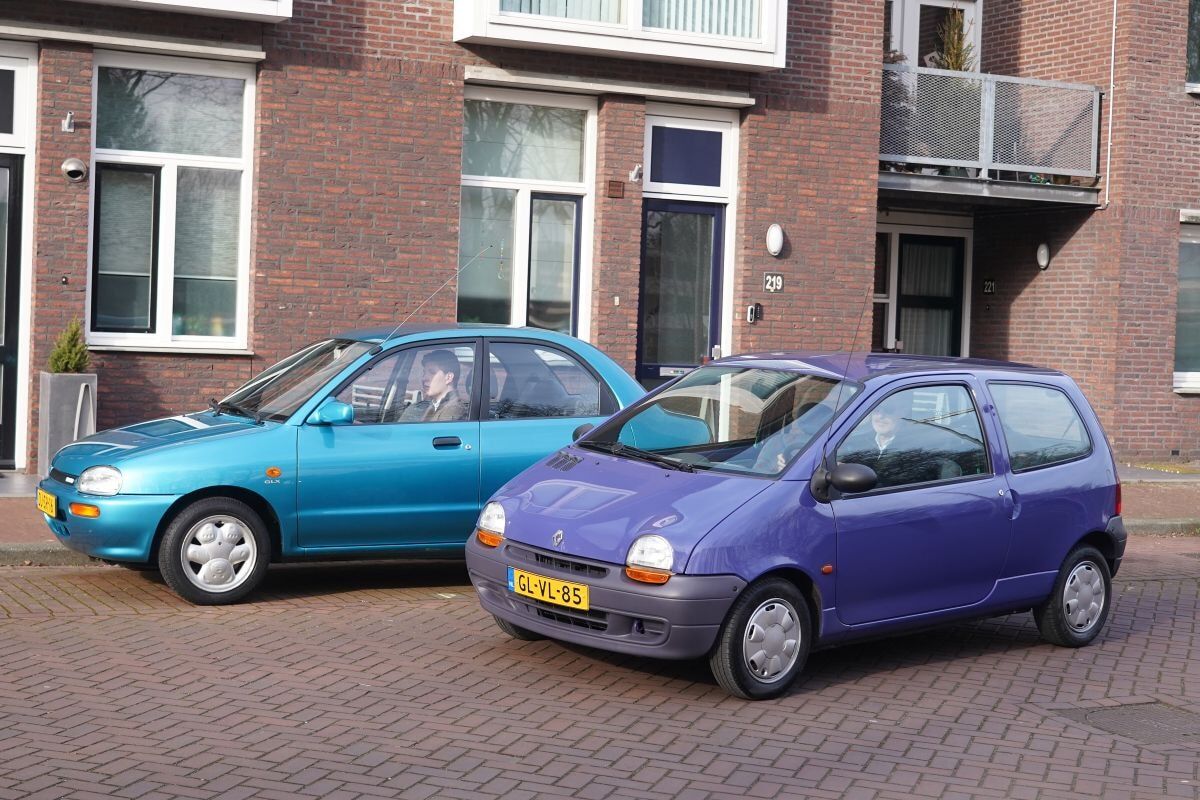
Given the low sales, it’s no wonder you hardly come across the 121 nowadays. But Mazda dealer Braber from Veenendaal has the GLX version in the basement and is willing to drive it out for the photo report and a test drive. Memories immediately come flooding back. As if it were yesterday, the amusing Japanese car manages to attract attention, partly thanks to its bright metallic sea-blue paint color and the unique bear-shaped rims.
Earlier, we picked up some early Twingos delivered in our country from dealer Van Kesteren in Kampen. On the way to Ede, we encountered five of them. Not a bad score. The Twingo was also supplied in many versions, such as the version with a folding roof and the Automatique and Initiale, which even has leather-upholstered seats. Likewise, it underwent an important facelift focusing on quality improvements and a new engine. In 2007, the last original Twingo rolled off the assembly line.
Sedan rear of 121
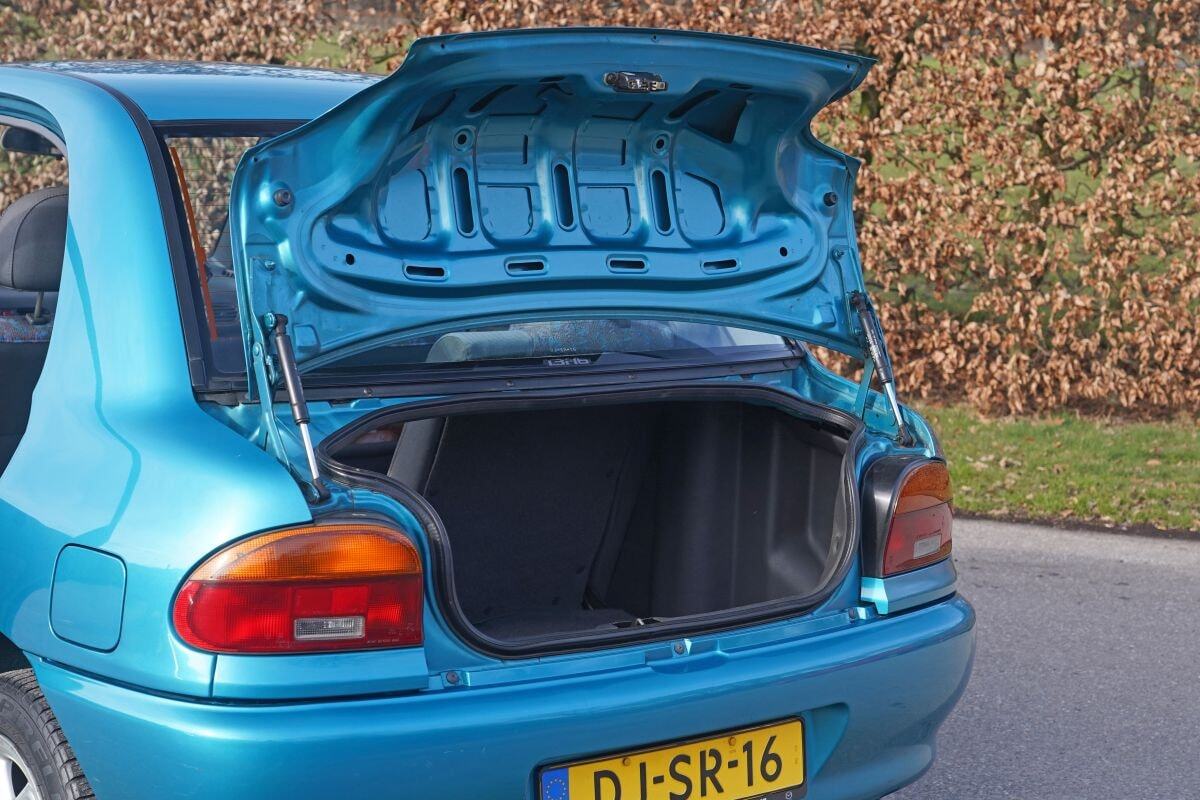
We could choose the Twingo to store our camera bag, but we deliberately opted for the 121, which immediately brought us face to face with the facts. Mazda was so wrong about that boot. If only they had put a large fifth door on it… Behind the front passengers, there is enough room for young teenagers. Adults from 1.85 meters will find their legs cramped, but have abundant headroom. In both cars, we are surprised by the amount of interior space, despite their modest dimensions.
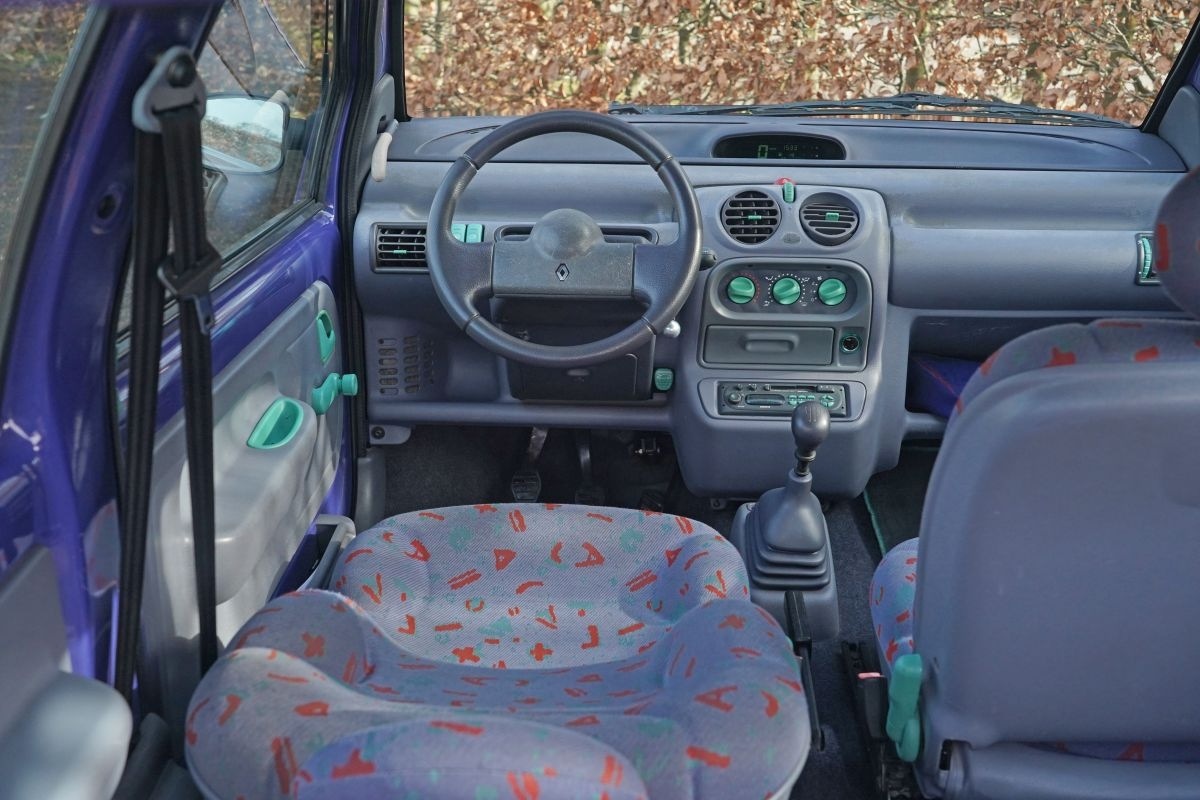
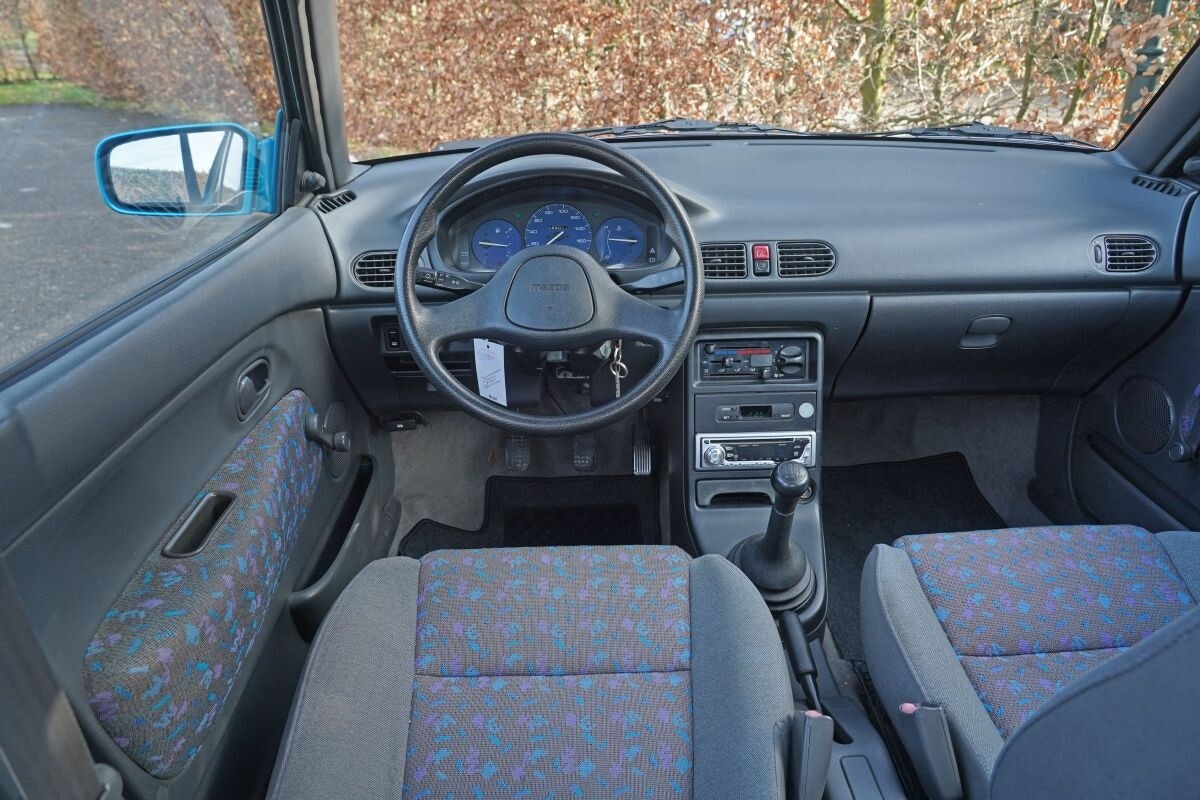
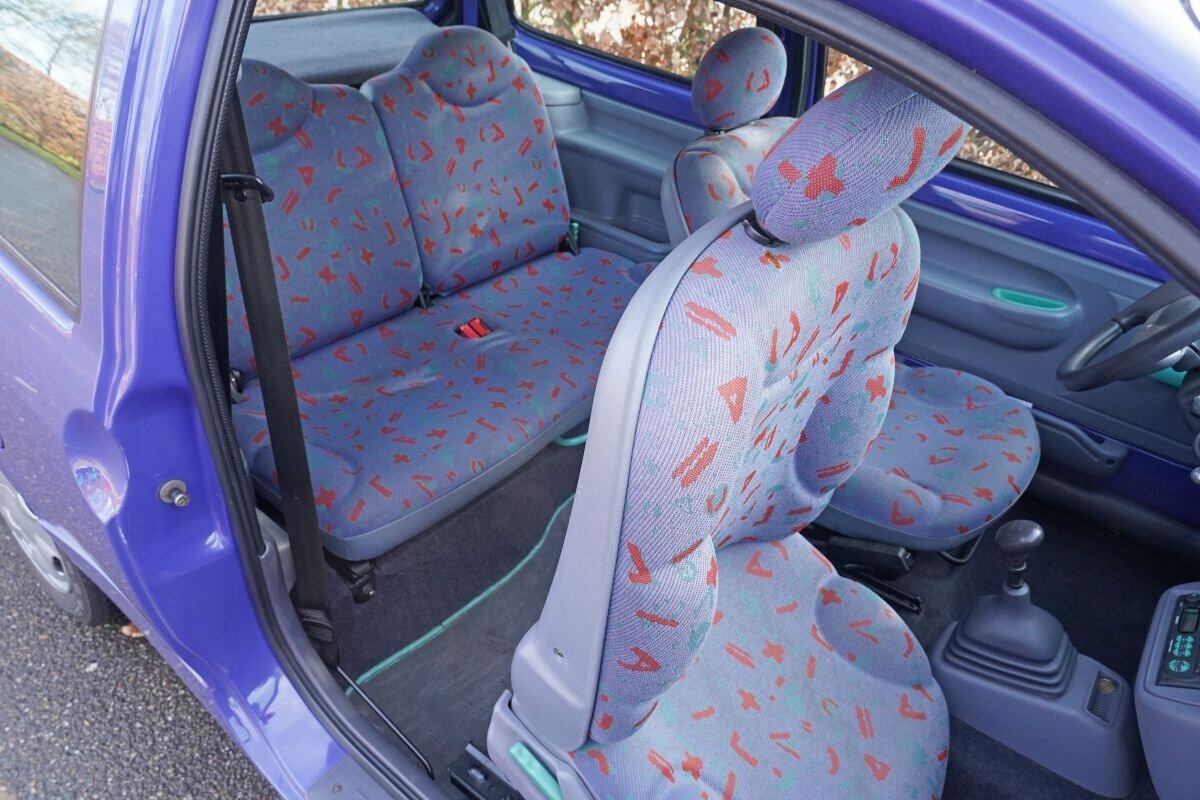
Frivolous designs are typical of the 90s, and the Twingo also excels in this. It makes it even bolder with its mint green switches and buttons. The driver gets a better seating position in the 121, thanks to the more mature seats and because the steering column is positioned more logically. In the Twingo, the steering wheel is high and relatively flat. This always results in an awkward driving position. The controls in the 121 are also more logical, and on the seats, although quite firm, you can endure it longer than on the short, somewhat soft cushions in the Twingo.
Sliding rear bench Twingo
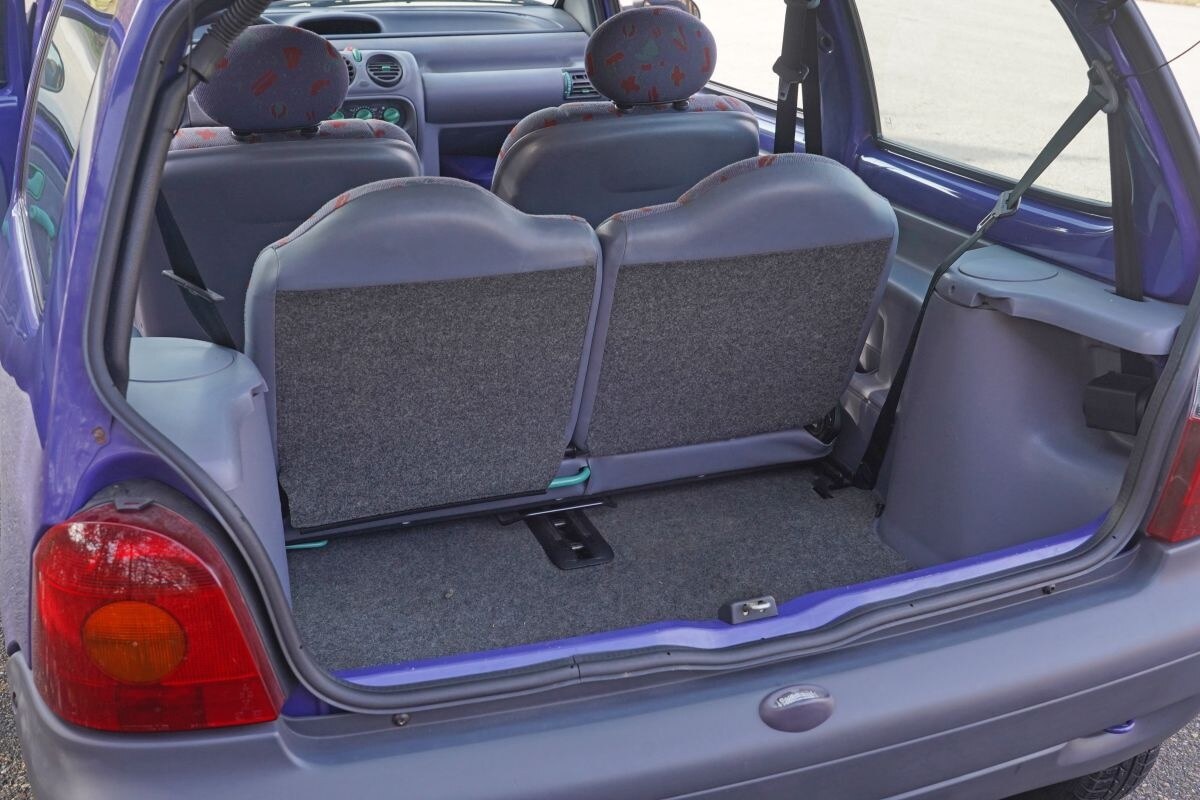
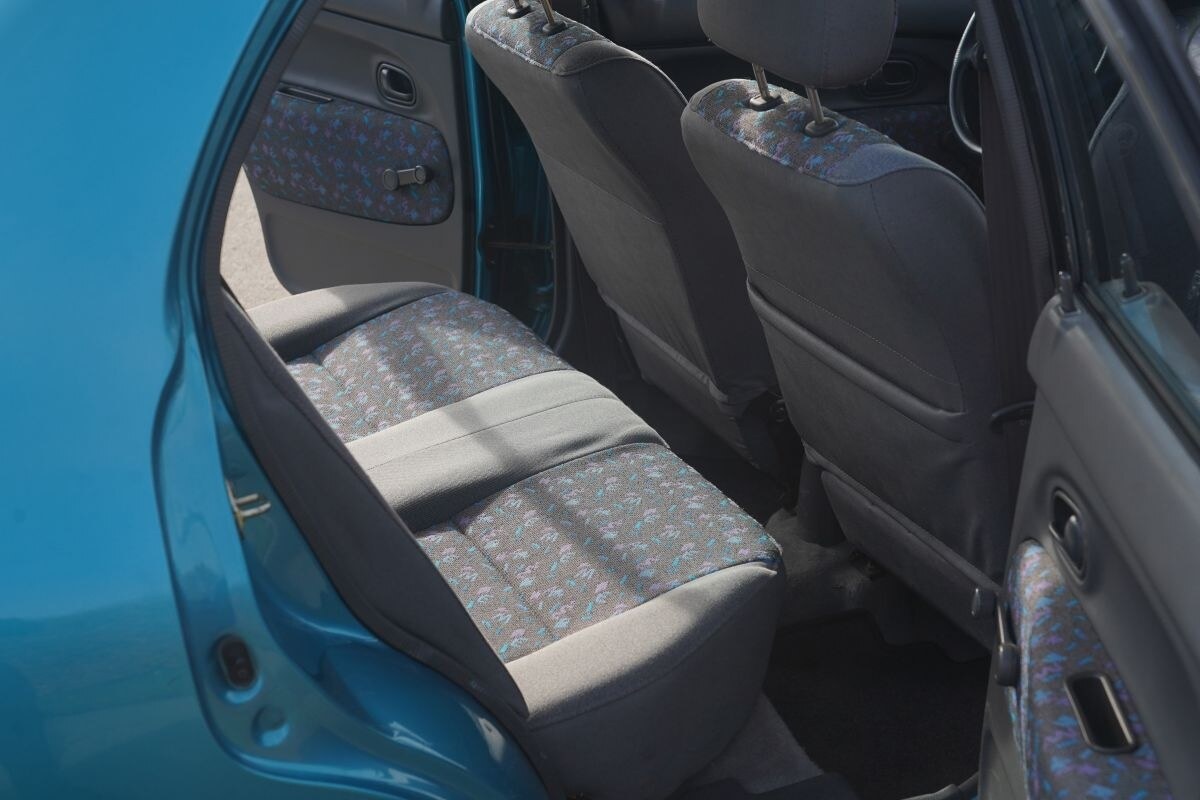
The rear bench in the Renault can be slid seventeen centimeters for more or less luggage or legroom. The French romantic soul dictates that you should be able to sleep in it, so all backrests can fold flat. We have to laugh at the French logic that opts for a lever to adjust the left exterior mirror from the inside, while the right one has to do without. Shouldn’t they have reversed that?
The 121 and the Twingo were designed for the urban jungle. They had to be compact and agile for parking and turning in one go. Yet, they lacked bumper strips and power steering, as well as central locking and electrically operated side windows. These are omissions that no one cared about in the 90s, but today’s Gen Z does.
With 55 hp, fine in traffic
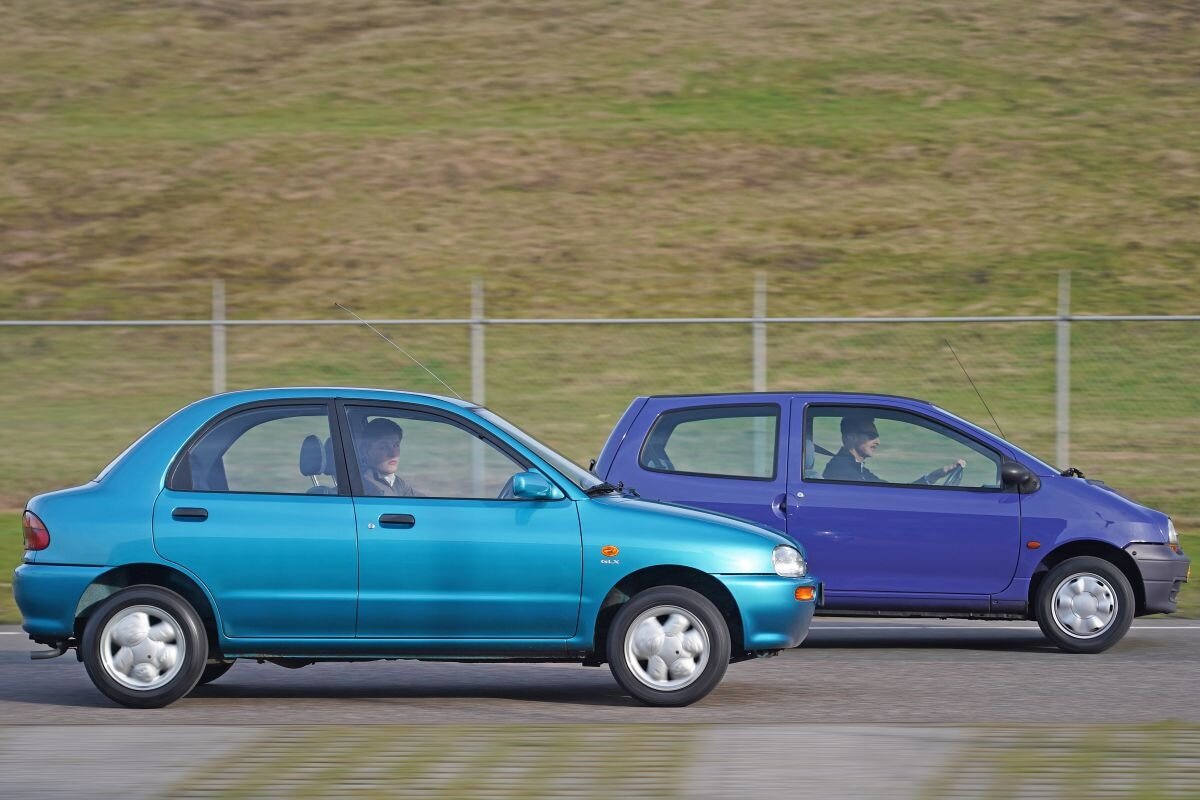
The cars are still as noisy as they were then, one of the main criticisms of both the 121 and the Twingo. The former generates a lot of road noise; in the Frenchman, the old Cléon Fonte engine hums at certain RPMs. We have to make do with a full 55 hp in this first Twingo generation. But thanks to its low weight, it still keeps up reasonably well in today’s traffic. The five-speed gearbox shifts typically Renault: long throws and difficult to get out of gear.
The 121 GLX already has a 16-valve engine with 73 hp. A 54-hp variant would have been fairer against the Twingo, but we don’t have a say in that. Of course, the five-speed gearbox shifts accurately, with short shift paths. As nimble and agile as the 121 feels – thanks to firm suspension, damping, and quick steering responses – the Twingo is understeering and leaning. It does, however, have comfortable suspension.
Only later the craze
Although we label the 121 as a flop, we are doing the model a disservice as such. We must appreciate Mazda for its courage to release this idiosyncratic model. But unfortunately, the brand paid a high price for the independently developed 121. The model flopped commercially. Its creators in the early 90s could not foresee the craze the bowler-hat dwarf would later create, from which it itself could not benefit.
This 121 is considered a precursor to a whole host of retro and quasi-retro cars that share the round, soft forms. The Ford Ka, the Volkswagen Beetle, the Mini, the Smart ForTwo, the Nissan Micra, and even the Renault Twingo. The Twingo with its equally original appearance, embraced by the masses. Also because of its versatility and that practical third door. After this original 121, Mazda sought cooperation with Ford, eventually settling for a rebadged Fiesta. Renault had every chance at the beginning of this century to continue the cute, sympathetic Twingo face, but to the dismay of many, chose a different course. But don’t worry: this year, the original Twingo will experience its rebirth in the form of an electric five-door variant.
There are still many first-generation Renault Twingos for sale; the Mazda 121 has pretty much gone extinction.