Sometimes it seems like everything has to be as thick and fast as possible these days, but what if it can be a bit more sober and, above all, cheaper? Then the recently facelifted Citroën ë-C4 is a good EV, although Volkswagen’s ID.3 offer currently seems even sharper.
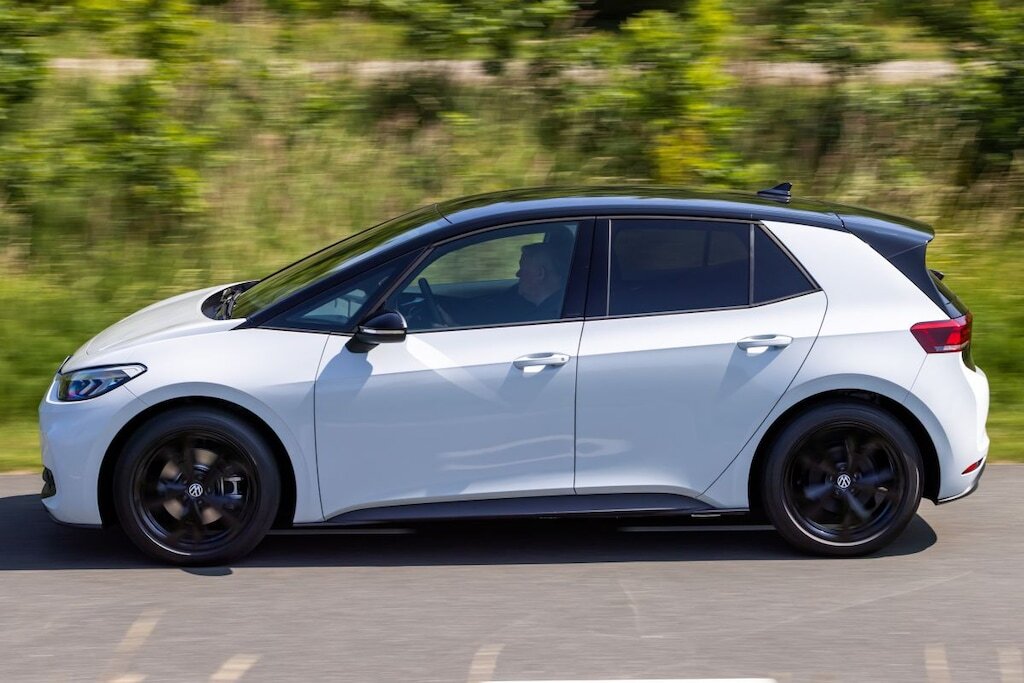
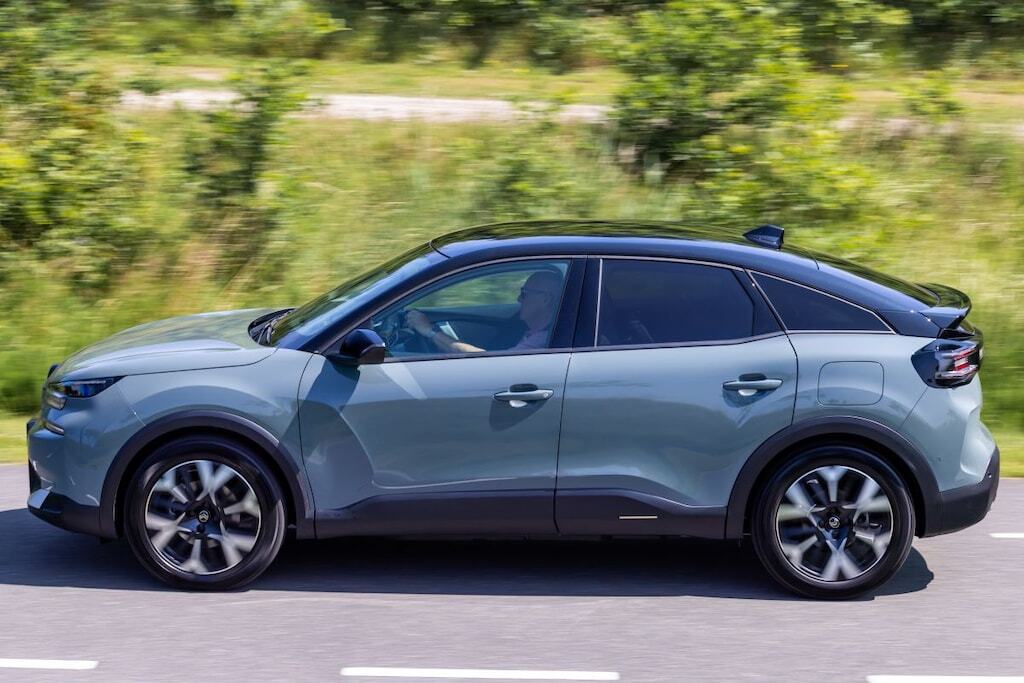
Hundreds of horsepower, four-wheel drive, from 0 to 100 in less than 6 seconds and gigantic SUV bodies that look like they can survive the Apocalypse: with the arrival of the EV, we have started to find many things normal. The answer to the question of whether all this is necessary is, of course, ‘no’ from a rational point of view. Nevertheless, this excess can largely be explained. High power and four-wheel drive do not impose a major consumption penalty on an EV and large, SUV-like cars can be sold all over the world, which means more potential and therefore attractiveness for the car manufacturer. Fortunately, there are still cars that are mainly developed with Europe in mind. The Volkswagen ID.3 and Citroën C4 are excellent examples of this, and also immediately show what that can mean. They both have well under 200 hp, they both only have one driven axle and they both have modest external dimensions and a neat hatchback body, although the C4 still has some cross-over features in the distance.
Prices
The most important thing is of course the price, because in both cases it is relatively modest. The heavily renewed ë-C4 is €2,000 cheaper across the board than before and if you go for the special Business version, you can get into a neatly equipped ë-C4 with the powertrain you want for €34,990, namely the 54 kWh version with a range of almost 420 kilometers. Neat, and let’s not forget that such a relatively friendly price also affects the additional tax liability for business drivers. However, Volkswagen does slightly better in that regard, because an ID.3 can now be driven for €29,990. That’s quite different from the almost 37 mille that an ID.3 had to cost in the starting year of 2020, and that against inflation. The ID.3 on these pages is such a Limited Edition, recognizable by the Black Edition package with black 19-inch wheels and other black exterior accents. The only option on this car is the white paint of €790, otherwise the test ID.3 is completely standard. That means we have to miss seat and steering wheel heating, a reversing camera, a wireless phone charger and even speakers in the back. However, the simplest ID.3 simply comes with LED lighting, adaptive cruise control, automatic climate control, parking sensors all around and an almost 13-inch infotainment screen. The tested ë-C4 is unfortunately not a modest Business, but the most expensive Max version. It costs at least €39,465. It is a bit weak that ‘Max’ at Citroën does not really mean the maximum. You still have to pay extra for a panoramic roof, steering wheel heating and a Level 2 driving assistant, which means that the 40 mille limit is still exceeded. Even if we assume the Business version, the C4 is more expensive than the ID.3, but it partially makes up for that with equipment, so it is not too bad for those who want a little more luxury. To finish the pricing story right away: without promotional prices, an ID.3 costs you at least €34,990, but then you suddenly have a wireless phone charger, navigation and seat heating. This version seems most comparable to Citroën’s Business, and the prices are even the same to the euro in that case.
MPV-like
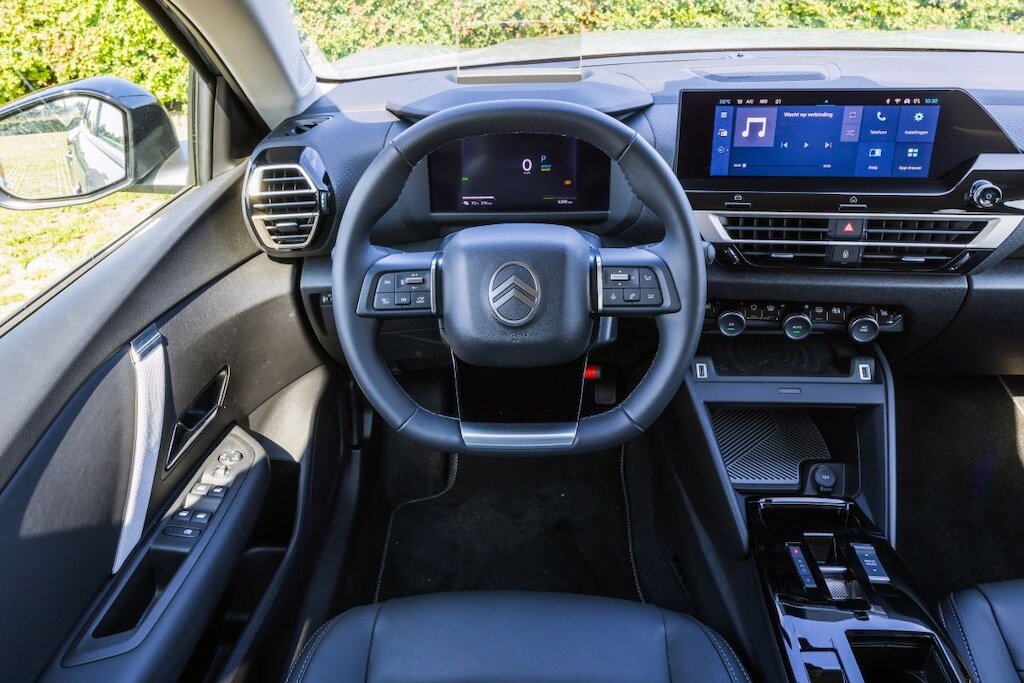
The renewed C4 is easy to recognize on the outside by its completely new front and clearly different rear lights. Citroën was a bit more careful on the inside, although we do find a new information screen behind the steering wheel and a new brand logo here. The quirky ‘drawer’ above the glove compartment has been cut back. The C4 interior is traditionally designed as before, and we mean that positively. There are rotary knobs for the climate control, many buttons on the steering wheel, countless compartments and trays and everything looks well-maintained and complete. Unfortunately, the infotainment system remains a weak point. The system is slow and not too clear, although Android Auto and Apple Carplay make it possible to live with it. The seats are comfortable and the seating position is pleasant, although longer drivers quickly sit with their legs raised. Rear legroom is also not excessive and it is also noticeable that the side windows are on the small side, although that may also be because Volkswagen’s rival lets in much more light.
Unlike the C4, the ID.3 is a car that is only available with electric powertrains. This has consequences for the complete design of the car and in this case means that the car has a somewhat MPV-like appearance, without a clearly distinguishable nose or rear. This means a deep dashboard, a huge windshield and a relatively spacious interior, because a large part of the length of the car is used for the interior. The flat floor also provides more space, which is used in the rear for the legs of the middle passenger and in the front for extra storage space. The interior is also ‘typically EV’ in other respects. The highly digitized and Tesla-like operating concept has already caused a lot of complaints over the years, but Volkswagen has finally gotten it somewhat under control. The ID.3 already received a facelift in 2023, but was equipped with a completely new infotainment system and a different gear lever in 2024. That infotainment in particular is significant, because this new system is much nicer than before. The screen is larger, it looks graphically a lot more mature and is simply pleasant to use due to cleverly chosen shortcuts and a high degree of configurability. That we would ever say that about the digital environment of the ID.3…
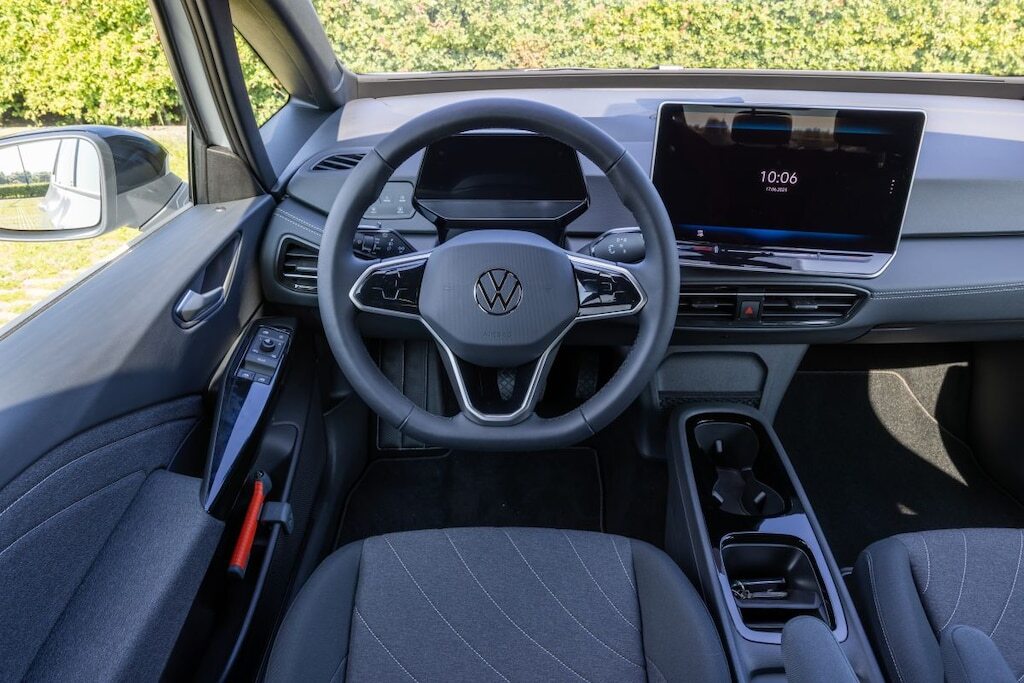
The dashboard itself remains a bit bare, but is well put together and looks more modern than the dashboard of the C4. Is that better? No, that is a matter of taste. That does not apply to the seating space in the back. Here the ID.3 is simply more spacious, and you seriously reap the benefits of the purely electric platform. In terms of luggage space, the French and German entries are evenly matched: the Volkswagen formally swallows a negligible 5 liters more and both have a fairly spacious loading space. That is a good thing, because neither of these cars is allowed to tow a trailer. A roof box can still be placed on the roof of the C4, the ID.3 does not have that option either.
Mailbox
The ë-C4 is available with two different electric powertrains, but the basic version is outdated and we actually consider it a so-called showroom lure. The variation is more realistic with the ID.3 and you can choose the Pure, Pro and Pro S. Each step brings more battery capacity and more range, while a Pro (S) also has more power than the Pure. The cheapest ID.3 is of course a Pure and with 52 kWh and 384 kilometers of range it is not even that far from what the Citroën performs in its most optimal form. What the Volkswagen lacks in range, it partially makes up for with a higher power of 177 hp. That makes the ID.3 nice and smooth, and it is very pleasant that the electric motor is on the rear axle. Drive reactions are therefore not noticeable in the steering and the turning circle is even extremely small, which makes the ID.3 a pleasant car in the city. You also have a lot of overview through the many windows, although it must be said that the huge A-pillars do throw a bit of a spanner in the works in that area.
The suspension comfort is fine, but the ID.3 is ‘German firm’. If that is indeed a thing, then the C4 is absolutely French soft. In this car, the suspension comfort is therefore particularly noticeable on the road. For some, this chassis is even too weak, but that clear choice is to be appreciated and the Citroën is indeed a pleasant touring car with this. However, the chassis can sometimes be a bit unrefined, because the relatively simple suspension of this Frenchman does have some difficulty with short bumps. The C4 also quickly becomes insecure at high (cornering) speeds, but it is simply not the car for that either. The steering is somewhat more insensitive and especially less direct than that of the ID.3, so that fits perfectly into the picture. By the way, the C4 is not fast, especially for an EV. ‘Smooth’ is more appropriate, and due to the relaxed character of the car, we have not felt the need for more power for a moment.
The reaction to ‘gas loose’ can be influenced in both cars by choosing a B-position, which causes faster braking and more energy is recovered. However, these cars only come to a complete stop when the brake pedal is used. The fact that the Volkswagen is always an EV is also reflected in a different starting procedure in practice. With the Citroën, this is traditionally done with a (too long) press of the start button, the Volkswagen starts automatically when the brake pedal is pressed. This usually seems handy and often is, but it also means that after a short stop at, for example, a mailbox, you have to manually switch off all the superfluous assistance systems again.