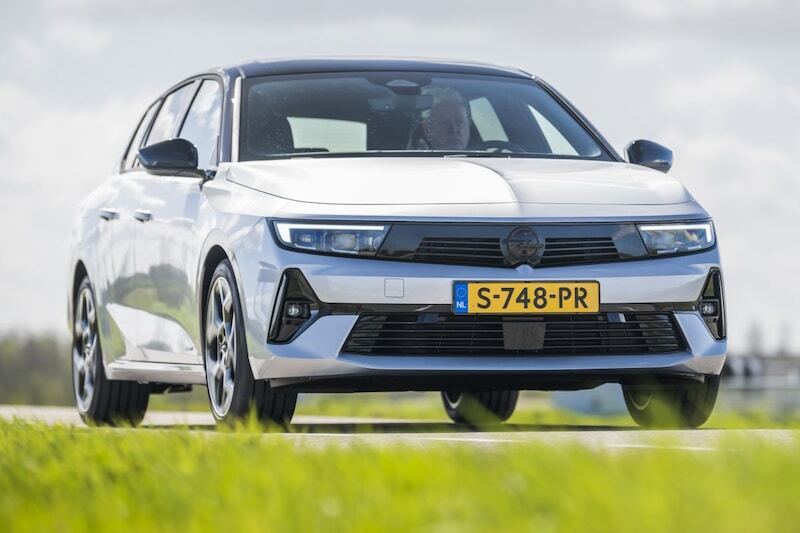
Now that the production of the Ford Focus has definitively stopped, there are fewer and fewer mid-range hatchbacks and station wagons left in the C-segment. We still have the Volkswagen Golf, the Toyota Corolla, and the Peugeot 308, among others. The Peugeot also has a sibling: the Opel Astra. Let’s examine it. Based on the opinion of the Astra driver, we will find out whether we should cherish this C-segment car.
The latest Opel Astra has been on the market since 2021 and has various forms. It exists as a hatchback and as a station wagon, which Opel calls the ‘Sports Tourer’. This also includes a wide range of engines and powertrains. The Astra is available with a turbocharged petrol engine, as well as with a plug-in and mild hybrid powertrain. Since 2023, the Astra has also been available as an electric car. There were also diesels, but they are no longer for sale.
Cramped in the Back Seat
The engine options are interesting, but let’s first look at the space on board. How much can fit in an Opel Astra? It offers enough space for golf equipment. An Astra Sports Tourer driver writes: “Nice spacious trunk. It was a requirement for two golf sets to take on vacation.” Another enjoys the space his hybrid station wagon offers: “The space is more than adequate for my work and vacations with the kids. Especially with a roof box.”
“The trunk is nice and spacious”, but the back seat is sometimes a bit cramped, several reviewers report. Also, the owner of an electric Sports Tourer finds that the space in the back seat leaves something to be desired: “What disappoints me is the interior space. I am 1.92 meters tall, and I don’t wish anyone to have to sit behind me.” Also, placing a child seat is just barely possible, he writes: “The Maxi-Cosi of my 3-month-old son fits behind my girlfriend, but only in the seatbelt. If we use the Isofix mounting with a plate on the floor, she would also sit with her knees against the dashboard.”
Quite Present Three-Cylinder
The Opel Astra comes in all sorts of flavors, but which drive is best? The 130 hp 1.2 liter three-cylinder with turbo is reviewed by two users. This reviewer was initially wary, but the engine is now fine: “The engine is quite present in terms of sound when accelerating, but once up to speed, it is really quiet thanks to the 8-speed automatic.” Another reviewer also has a comment about the engine noise: “The 130 hp three-cylinder drives fine. It sounds a bit like a cold dachshund.” That ‘cold dachshund’ is linked to a manual gearbox, which disappoints: “The manual gearbox looks and feels awfully cheap. It is a kind of Playmobil plastic in a hideous shape. Shifting is also a bit vague and weak.” These two drivers note a consumption of 5.6 liters per 100 kilometers (1 in 17.9) and 5.4 liters per 100 kilometers (1 in 18.5) respectively.
Economical Mild Hybrid
There is also a mild-hybrid 1.2 turbo. The combustion engine and the electric power provide a combined power of 136 hp. That makes the car fast enough, writes this Astra driver: “You get along well in traffic. Overtaking quickly is perfect, especially in the sport mode.” Here too, we cannot ignore the engine noise. One reviewer thinks the car makes a ‘grunting’ sound when accelerating.
This driver is extremely satisfied with the interaction of the electric and gasoline power source: “Nothing but praise for the mild-hybrid technology. It has a small motor in the gearbox that also allows the car to drive small distances electrically. If you drive a constant speed up to about 65 kilometers per hour, you can just cover pieces electrically.” That appears to reduce consumption. The reviewer consumes an average of 4.8 liters of gasoline per 100 kilometers (1 in 20.8). The other mild-hybrid driver writes that he drives 1 in 20.
Quickly Responding Plugin
Then there is also the 1.6 liter four-cylinder plug-in hybrid, with a combined power of 180 hp. That makes the Astra nice and fast: “Accelerating with battery and gasoline is nice and quick. In sport mode, the car shoots away completely.” The power provides pleasure, writes an Astra driver: “It responds really quickly to the throttle. I like that!”
Driving fast is of course not economical, but if you drive 100 km/h you can achieve a consumption of 5.3 liters per 100 km (1 in 19.0). With plug-ins, if you load neatly and try to drive as much as possible on electricity, you can achieve a very low consumption. This driver succeeds: “If I load neatly full, an average of 3.1 liters per 100 kilometers (1 in 32.3)” But driving a lot electrically is a challenge with the limited range. The Plug-in Opel has an electric range of 67 kilometers according to WLTP. “Forget that. If you reach 40 kilometers, that is a lot,” writes the same reviewer.
That range has increased, because Opel has renewed the plug-in powertrain of the Astra this summer. In addition to a larger battery pack, the plug-in also received more power.
Electric Astra does not reach the WLTP value by far
The powertrain story is not over yet. In 2023, Stellantis still saw room for the Opel Astra Electric. Equipped with a 54 kWh battery and a powertrain that sends a power of 156 hp to the front wheels. It is fast enough, writes this Astra driver: “The engine in normal mode already gives more than enough oomph to get along well in traffic and occasionally win a short sprint, so I’ll leave the sport mode alone for now.” That also helps to increase the range. According to the WLTP, it is 418 kilometers for the hatchback and 413 kilometers for the station wagon, but in practice you get a lot less. This reviewer drives in the cold and on winter tires: “With normal use, without driving too hard, 250-300 km is perfectly feasible, but not much more than that.” The other reviewers also do not come close to the WLTP value in winter. The range is between 300 and 350 kilometers for one and the other drives between 230 and 250 kilometers on a charge. For the long distance, the range and charging are fine according to this driver: “During a longer trip to southern Germany, I concluded that peeing and drinking coffee takes about as long as fully charging the car from 20% to 80% and that way you calmly go another 250-275 kilometers if you do not drive too hard”
To recover some power, the electric Astra brakes on the engine: “Not quite one pedal drive, but it comes close,” writes this EV driver about that.
This generation Opel Astra was and is supplied with many more powertrains. Take a look in our carbase for an overview.
A Balanced Chassis
The reviewers are positive about the chassis and road holding of the Astra. This plug-in driver finds his Astra well balanced: “The car is tight on the road. Somewhat stiff suspension, but also comfortable. You take thresholds perfectly.” A mild-hybrid driver agrees: “Driving comfort is great, a very tight and smooth road holding.” Another is also satisfied with the chassis, but feels that his plug-in Astra station wagon with 1,617 kilos is not light: “However, you notice by its weight that it tends to ‘mop’ if you step on it hard at an exit or entrance to a highway.” This reviewer finds the chassis of his electric Sports Tourer sometimes too firm: “It drives very well, although I sometimes feel the bumps in the asphalt just a little too well.”
Fine Seats
The Opel Astra can be equipped with AGR seats. The Peugeot 308 drivers are praising about these, so the expectations are high. The AGR label means that the seats meet the requirements of the German association Aktion Gesunder Rücken. This Astra driver can recommend them: “The AGR seats are great. Definitely check if they are not standard in the chosen version.” Another reviewer has found a small downside: “The seats are wonderful and are widely adjustable. It is a pity that only the driver’s seat has an extendable lumbar support.”
Interior and Infotainment
This generation Opel Astra is a product of Stellantis and that is reflected in the interior. Yet the driver of a hybrid Astra in the ‘edition’ version finds the cabin distinctive: “I think that Opel has really created something cool. Of course, the influences of Stellantis are visible, but Opel has its own identity here.” That own identity does not excel in ease of use, writes the owner of an Astra Sports Tourer: “The dashboard has two separate monitors with a totally illogical operation, nowhere intuitive and rather confusing. The worst thing is that the layout of the primary functions, such as the speed and the speed, seems to come from an old Citroën BX or GSA. Very annoying. And why that is not customizable to beautiful clocks or something else is completely unclear to me.”
Not everyone is so dissatisfied, but the ease of use of the Astra does not convince either: “In terms of operation, it all works reasonably smoothly, although sometimes it is a bit of a search whether you can adjust things and where then.” The physical buttons are to everyone’s taste: “You get into the ADAS systems via a physical button, which I like. Just like the many other physical buttons such as those for ventilation, temperature and sound.”
The Opel Astra is optionally equipped with a head-up display so you do not necessarily have to take your eyes off the road. That works well for this reviewer: “Super handy! Speed, adaptive cruise control and other warnings are clearly projected onto the windshield. That prevents distraction.”
The center console is equipped with piano lacquer, but that is sensitive to dirty fingers: “I keep polishing.”
Slow Software
Several users are annoyed by the slow, sometimes faltering software used in their Astra. “In terms of software, Opel really drops stitches. For example, the image of the rear view camera really comes on the screen far too late when you put the car in reverse. Sometimes you just have to wait 10 seconds,” writes the driver of an electric Business Edition. Starting the navigation can also take a long time, this reviewer says. Furthermore, the audio installation in the Opel Astra is not fantastic, several Astra drivers write. The driver of an Astra Electric misses a subwoofer in his version: “The sound is fine, but lacks some bass due to the lack of a subwoofer.” Opel also has an app, but according to these reviewers, you better leave it alone: ”The ‘myOpel’ app works more not than well.” The other app user writes: “Unfortunately, the app costs 120 euros per year, which I find quite pricey for a slow app that misses quite a few functionalities.”
For the time being, little seems to be broken on the reviewed Opel Astra’s. During the service of a mild-hybrid Astra, some oil consumption came to light: “Oil consumption was 0.5 liters. That seems to be of good nature according to the dealer.” Furthermore, no serious defects have occurred on the Opel Astra to date.
The entry-level Opel Astra hatchback has a new price of 33,999 euros. For the station wagon you pay a thousand euros extra. If you are interested in a cheaper used Astra, be sure to take a look at the used cars on AutoWeek.nl.