Growing problem
The Dutch are embracing electric driving, but the fire department has much more trouble extinguishing plug-in cars. This was recently apparent again in several car fires. Extinguishing an electric car is time-consuming and risky. Unfortunately, a real solution for the fire department does not yet exist.
It happens regularly: an electric car that catches fire and causes chaos. For example, in April a supermarket in Enschede had to be evacuated because an electric vehicle (EV) burned down in the parking garage. In June, the cargo ship Morning Midas had bad luck on the Pacific Ocean. A fire broke out in the storage area for almost eight hundred electric and hybrid cars. The crew could not put out the fire and had to leave the ship. It was reminiscent of the burning ship with electric cars above the Wadden Islands, two years ago.
How on earth do you extinguish an electric car? The fire department does not yet have the perfect solution for this. It is necessary, because more than a million Dutch people are already driving an electric vehicle. And they are also becoming increasingly affordable.
Because more EVs are driving around in the Netherlands, the number of incidents with an electric car is also increasing. In 2024, this was 10 percent higher than a year earlier, according to figures from the Dutch Institute for Public Safety (NIPV). In 221 of the 356 cases, the vehicle caught fire and in a quarter the battery. A battery pack that spontaneously catches fire is rare, emphasizes the NIPV. More often, a car fire is caused by defective wiring or arson. The fire department still has more difficulty extinguishing it.
Extinguishing EVs is difficult because the battery pack is deep in the car floor. Such a package consists of many small, closely packed battery cells. If one catches fire, a chain reaction can occur in which other cells ignite. The car continues to burn or can even reignite hours later. The vapors from the battery cells are also toxic and highly flammable, creating an explosion hazard.
Dipping bath
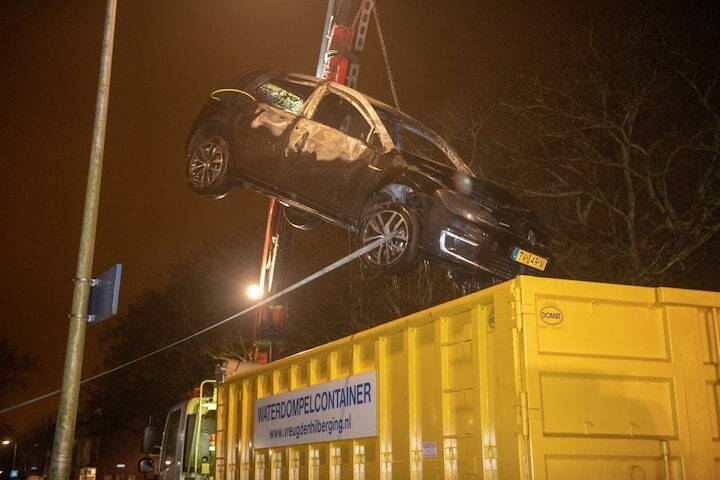
The immersion container is a way to thoroughly extinguish EVs. Bergingsbedrijven then lift the car into a container and place it under water in a safe location. “A recovery company once came up with this method by lifting a smoldering plug-in car into the ditch,” says Esther Lieben of Brandweer Nederland and the national task force Safe Energy Transition. “The immersion container is still the most commonly used extinguishing method for a battery fire in our country.”
The Dutch government wants all road traffic to be emission-free by 2050. Freight transport must also be plugged in, which means that all new trucks will be electric from 2040. These absolutely do not fit in an immersion container. The NIPV is currently investigating solutions for e-trucks. It has already introduced a new extinguishing method for electric cars, which has been used by corps in The Hague, Rotterdam and Utrecht since this year.
Hole in the battery pack
The system is called UHD (ultra-high pressure), says Tom Hessels, NIPV advisor for energy and transport safety. “The jet contains metal particles and is so concentrated that it can spray through a wall.” The UHD system drills a hole in the battery pack and then submerges the battery cells with extinguishing water. Sounds good, but Lieben is critical. “Hold your hand in front of the jet and you’ll have a hole in it. So we are careful with the deployment of the system.”
Each UHD team consists of six to eight people to operate the sprayer and secure the area around the burning plug-in car. The firefighters undergo special training for the system. “It costs a lot of time and money,” says Lieben. “Personally, I would therefore only let the well-trained specialists handle UHD. It is less suitable for fire brigade volunteers, they have too little time for training and maintenance of this specialism.”
‘Ban in underground garages’
Letting electric cars burn out is not an option in, for example, a residential area or a parking garage. Lieben would prefer a national ban on plug-in cars in underground garages, so that fires such as those in Enschede do not get out of hand. “I have seen a building go up in flames because a burning electric car was unreachable five floors below ground.”
Lieben thinks that safety will already be improved if EVs and charging stations are only allowed at the entrance to a parking garage. “Unfortunately, our safety team is often invited too late to a construction project to advise on the design plans. Sometimes we are even laughed at a little.”
In the Netherlands and the rest of the EU, no new fuel cars may be sold from 2035. The number of plug-in cars is expected to increase even faster in the coming years.