The Trend That Faded
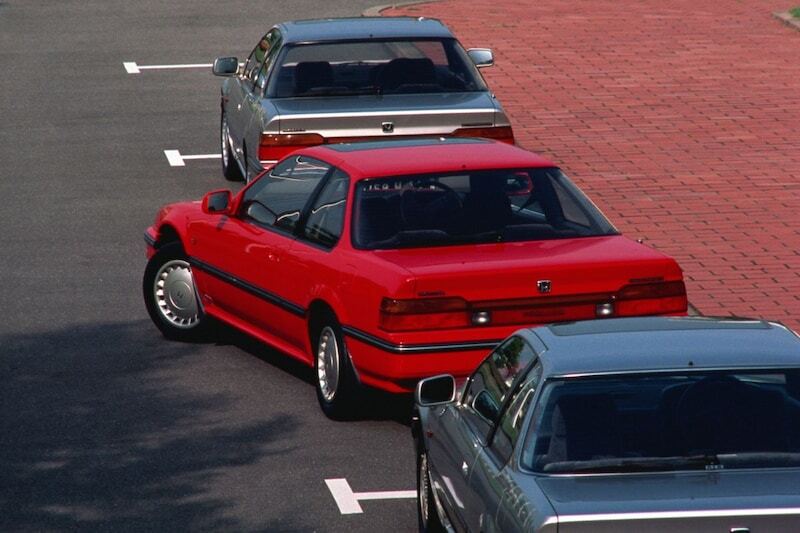
In the mid-1980s, Honda was convinced that it had set a new trend with four-wheel steering. But widespread adoption failed to materialize, no matter how hard the Prelude 4WS tried from 1987 to demonstrate the benefits.
Interest in four-wheel steering (4WS) was mainly expressed by Japanese brands in the 1980s (Mazda 626, Mitsubishi Galant, Nissan Skyline and the Honda Prelude described here), but then declined. The system has now made a comeback, as the Renault Austral, Audi A6 and Mercedes-Benz EQS prove. The reason for having the rear wheels steer along is still the same: it provides extra stability at high speeds (rear wheels steer along) and makes the car easier to handle when maneuvering (rear wheels steer against). Regarding the latter, Honda claims that 4WS reduced the turning circle of the Prelude by one meter. This may not seem so relevant for a compact sports coupe, but it does underline the impact of the system. Turning around in a narrow street is much smoother!
Easy Parking
In the Prelude, 4WS works purely mechanically, because an extra pinion on the rack of the front wheel steering is connected to a steering gear at the rear axle. Two tie rods are moved there, which in turn change the steering angle of the rear wheels. With a limited steering angle they steer slightly, with much more turning (parking) they first straighten again and then turn in the opposite direction. Nicely conceived, but it has the (albeit almost hypothetical) disadvantage that with very far steering during the correction of a slip, the rear wheels interfere with the direction of the car. In other words: the oversteer you then have to deal with is amplified by the counter-steering of the rear wheels – exactly what you don’t want then. Partly for this reason, an active system is better, which works independently of the front axle via electrical control.
2,000 Guilder Surcharge
In fast corners, the Prelude 4WS behaves exemplary, although the normal version is also quite capable in that area. Was 4WS worth the surcharge of 2,000 guilders (on the 2.0 8V and 16V) at the time? Absolutely for the lover of high-quality automotive technology. Everyone else must have thought: I can also do without it just fine. The completely new Prelude very wisely puts its powerful, hybrid powertrain and the special automatic transmission forward as strong points. Completely according to the trends. Four-wheel steering is beautiful, but not a plus for the new Prelude.
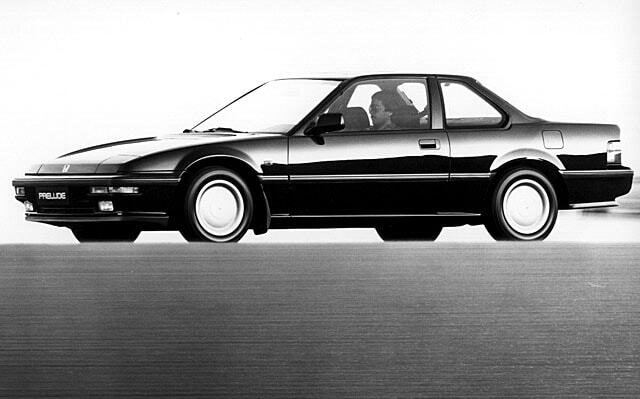
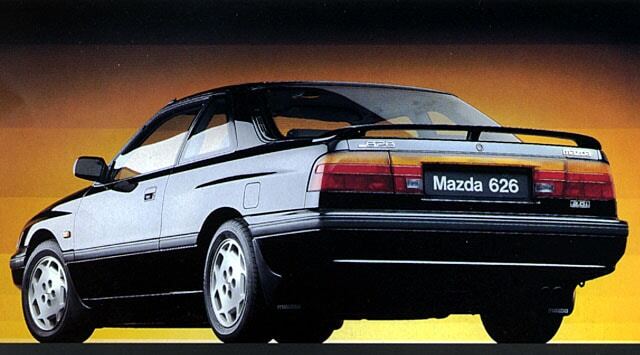
Incidentally, several competitors also had the technology, of which of course the 626 Coupé was a direct competitor.
Signaling
Specifications
“`