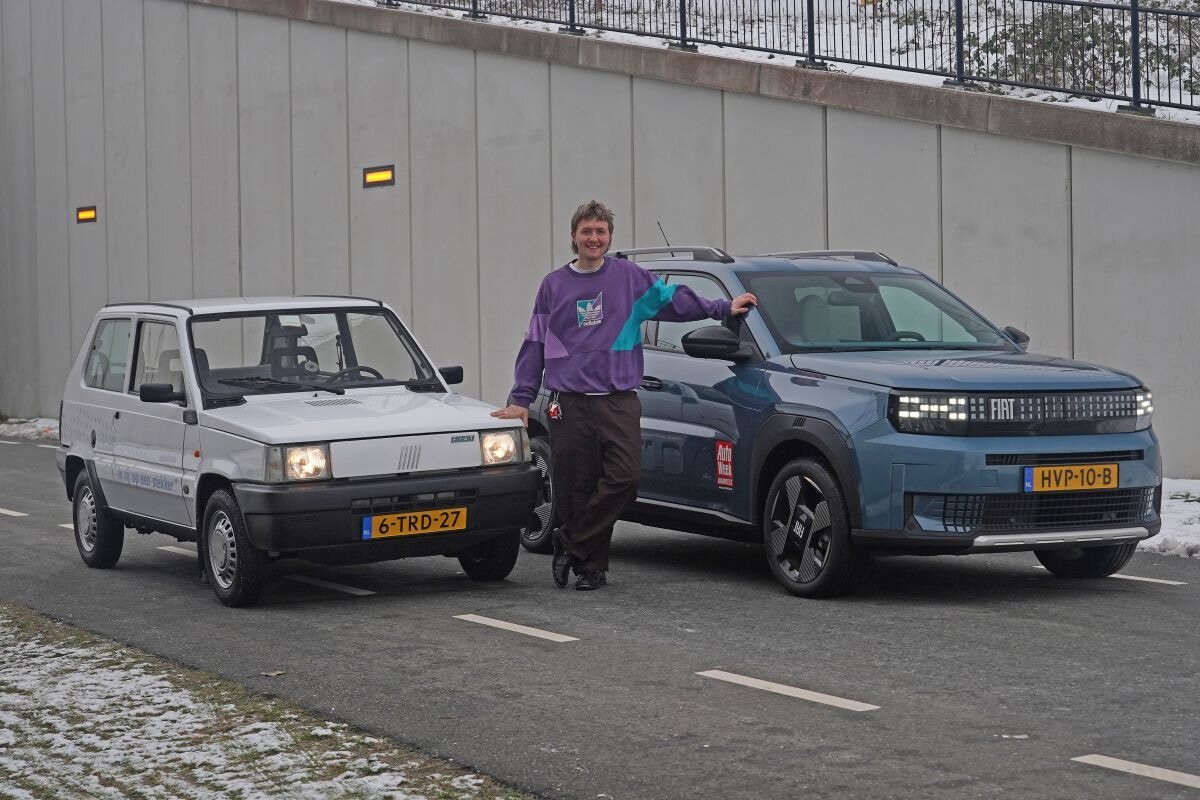
Did you know that the Fiat Panda is the first commercially available EV ever? As early as 1990, Fiat had the audacity to equip the city car with an electric motor. A forward-looking vision, although it was too far ahead of its time. Now Turin is trying again with the Grande Panda.
This statement, spread by Fiat itself, is not entirely correct: a year earlier, a Swiss truck company offered a self-developed electro-Panda.
Try to get an original Panda Elettra in front of your lens these days. It’s hardly rarer than the almost 36-year-old electric version of the former bestseller. Yet, it’s a piece of cake. Wijnand Zwart featured in an AutoWeek report in 2018 with his beloved Panda Elettra. So, hop, look up the phone number and it’s done. Unfortunately. Wijnand had handed over the car to the next generation a week before we made contact.
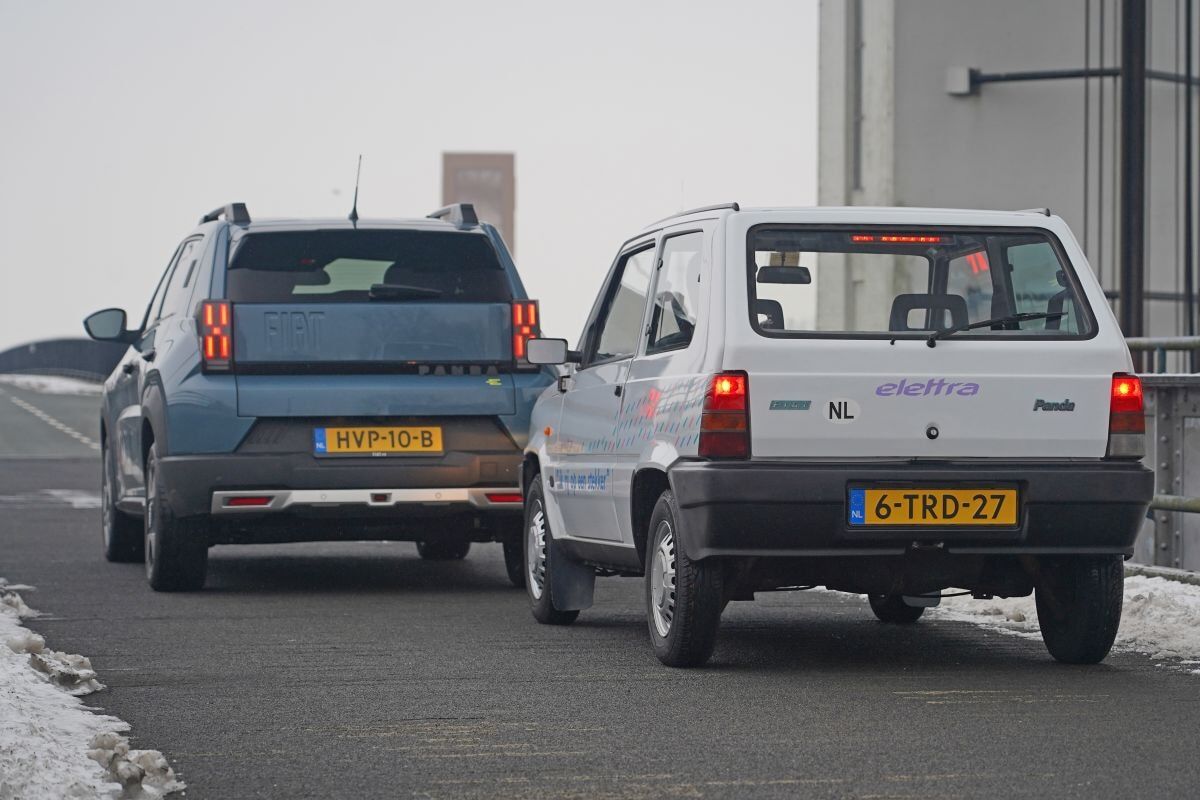
This Panda Elettra goes 20 kilometers further
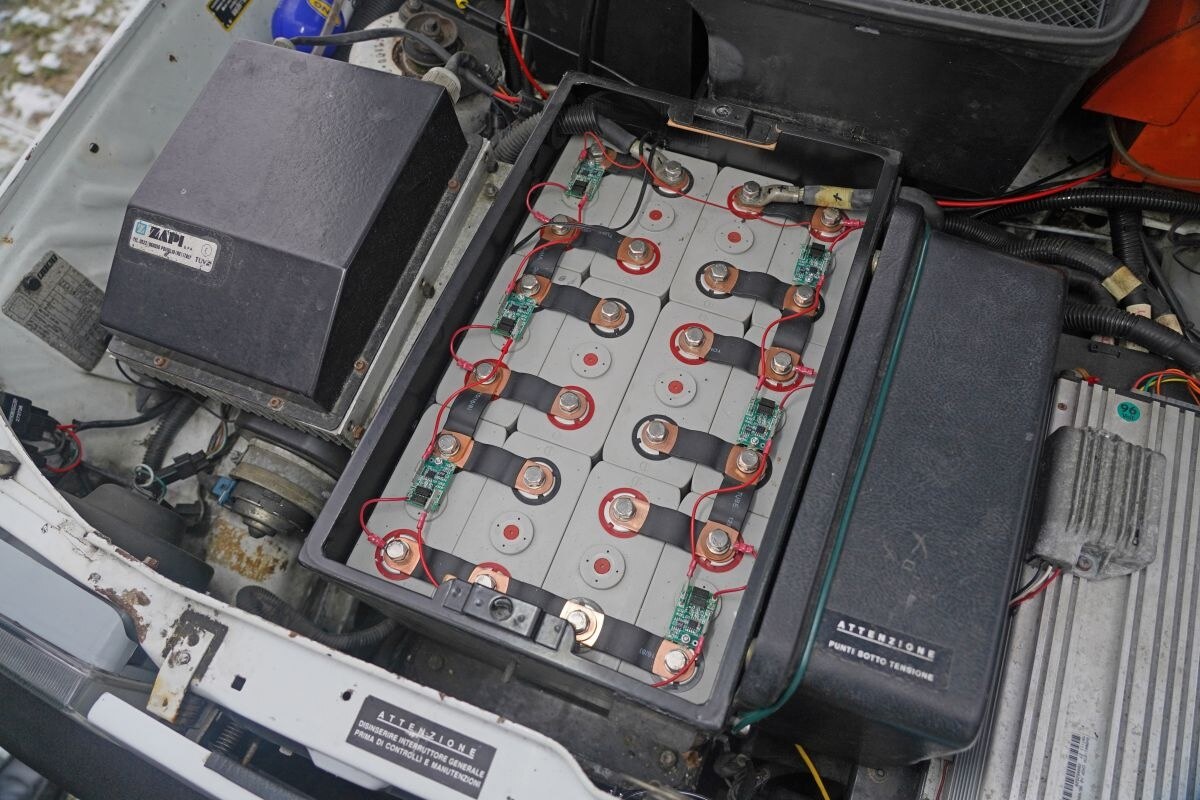
We missed, we suspected. But Wijnand helped us get in touch with the new owner. That’s how we ended up with 30-year-old sound engineer and ‘master energy science’ student Gonard Fluit. What does he want with such an old and slow EV? One that also needs to be charged every 100 kilometers? “Uh… 120 kilometers,” he corrects. “Wijnand was kind enough to give the Panda some more modern components. He replaced the original lead-acid batteries, which had no power left, with modern lithium-ion packs. He could have bought a new Panda with that money, that’s how expensive those things were ten years ago. As a result, the voltage increased from 72 to 96. And with it, the range and top speed increased from 60 kilometers to, in favorable conditions, 120 kilometers, and from 70 to 100 km/h top speed. The latter thanks to the self-made roof spoiler and the taped-up grille.”
Panda Elettra was always a two-seater and still weighs 1,150 kilograms
The battery packs are distributed throughout the Panda: a part under the hood above the Danish DC (direct current) electric motor, the vast majority replaces the rear seat and half the luggage compartment. This EV was always a two-seater. And don’t forget that a regular first-generation Panda weighs only 700 kilograms, the Elettra 1,150. With the more modern batteries, it’s 920 kilograms according to the registration. This also explains the newer passenger car registration, as there is again space for the rear seat. “Heavier springs, brakes, and larger tires with a higher load index were a pure necessity, rather than superfluous luxury.”
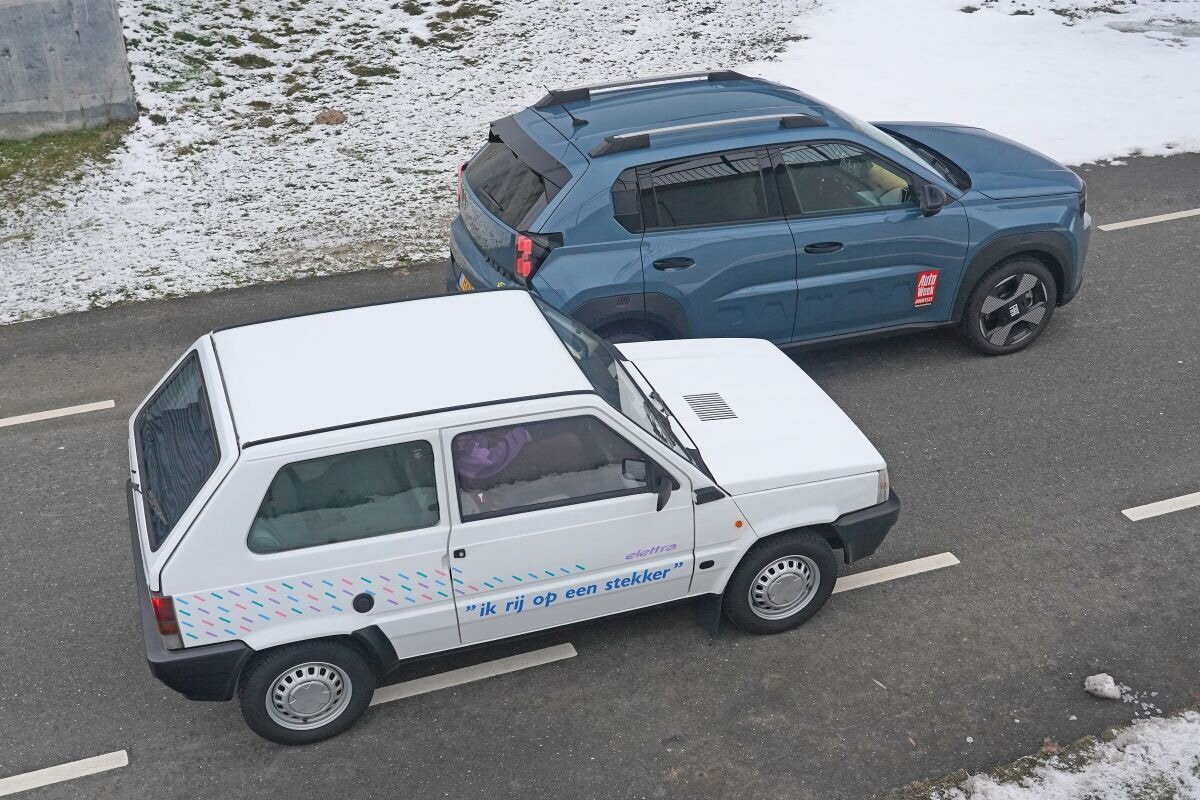
‘Grande’ aptly chosen
“What a difference, right?” Gonard remarks, observing the youngest Panda. Strictly speaking, they only share part of their name. “I wonder if the new one is still a Panda.” There are 44 years between the original and the fourth generation. The distant predecessor is a meter shorter and 25 centimeters less wide than the youngest Panda. It also has two more doors compared to the original. ‘Grande’ is therefore an aptly chosen addition to the existing model name, although you won’t find that addition anywhere on the car itself. In fact, the name is the only similarity between both EVs, because the original version and its two successors operated in the A-segment, while the youngest descendant was promoted to the B-segment.
Original Panda, Giugiaro’s masterpiece
The design of the original Panda was created by Giorgetto Giugiaro, while Aldo Mantovani was responsible for the technology. The now 87-year-old Giugiaro considers it one of his most successful designs in his long career. It was all about absolute simplicity to keep costs as low as possible. Minimalism at its best. For the outliers, calls went to Steyr-Daimler-Puch in neighboring Austria. First for the 4×4, later – in the late 80s – again, but for the conversion to EV, because Fiat wanted to take the lead and outpace every competitor. Fiat sent Pandas in the somewhat more luxurious ‘CL’ version to Graz. There, the 750-cc Fire engine and its appendages made way for a direct current electric motor of Danish manufacture.
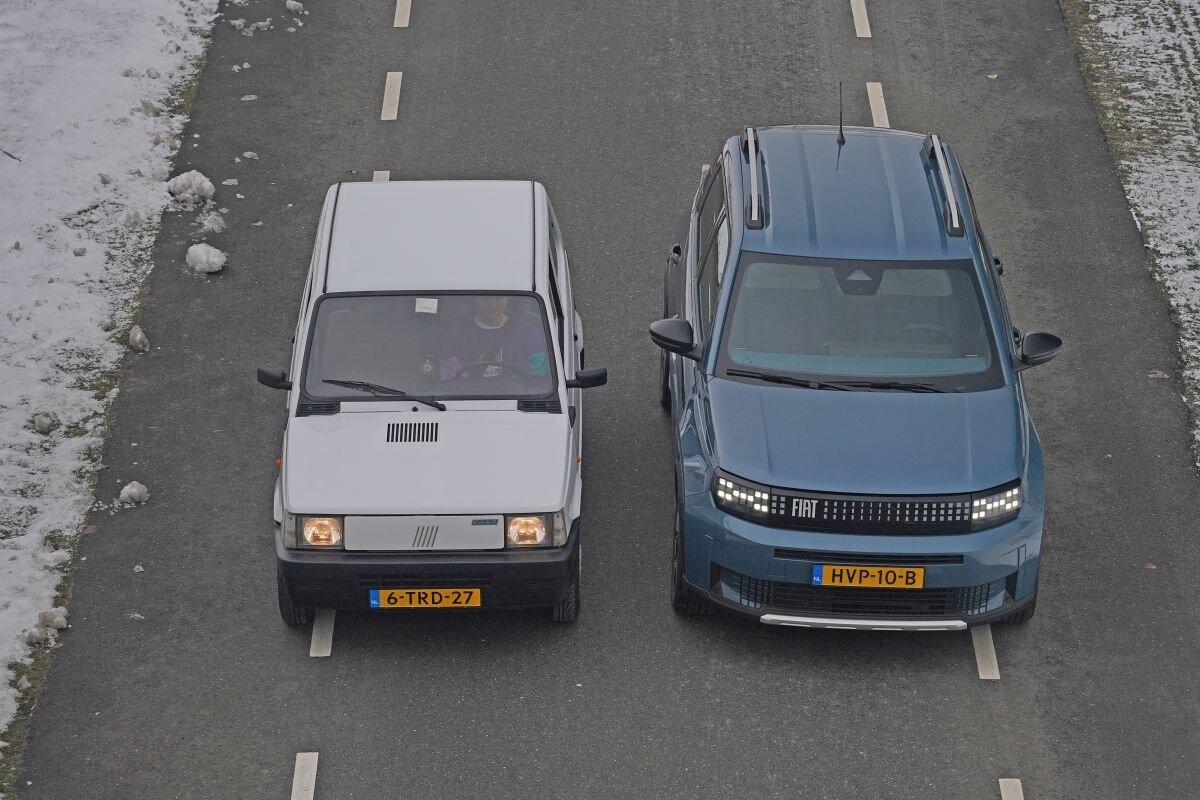
Angular design of the Grande Panda
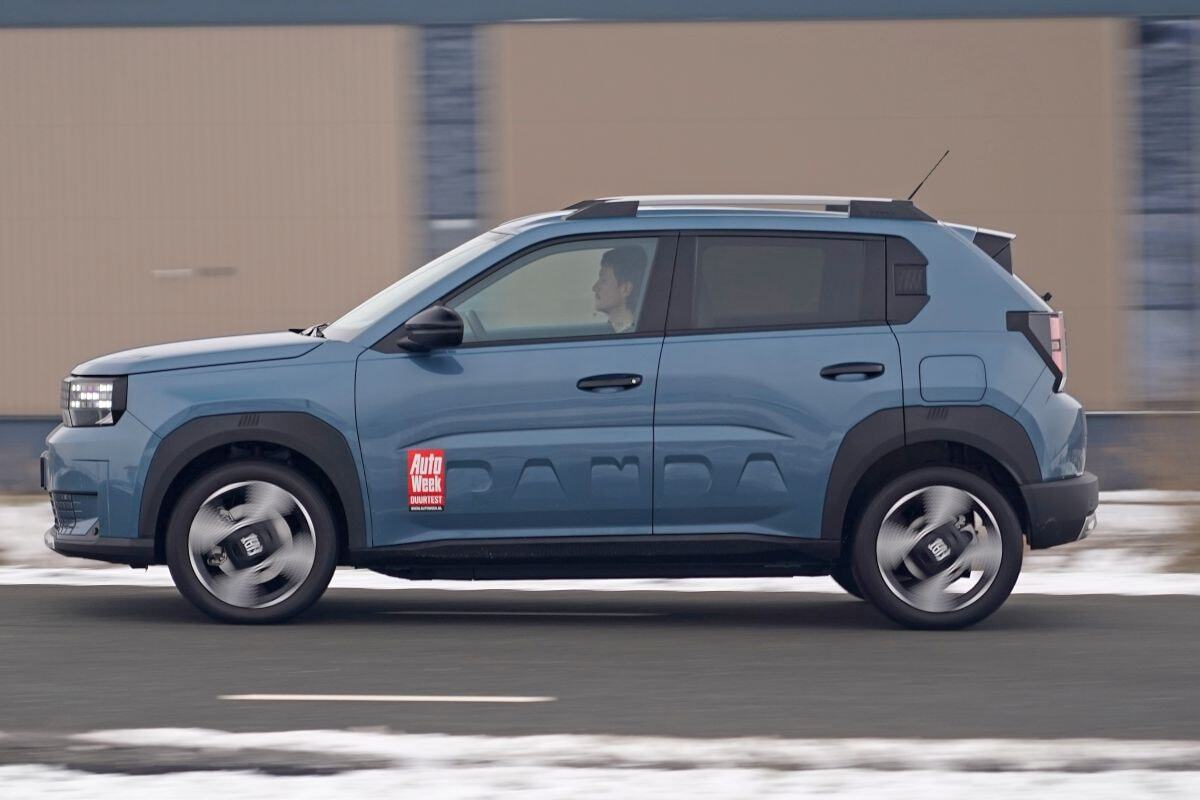
The striking design of the Grande Panda was created under the leadership of François Leboine within the Smart Car Platform framework of Stellantis. It shares its vital parts with the Citroën ë-C3 and the Opel Frontera. That’s why it stands a bit higher on its wheels, as if it were a crossover. Nevertheless, the youngest Panda does have similarities with its distant ancestor: specifically, the angular design refers to the simple design language of the original. In addition, the cubic light design with X-shaped daytime running lights is inspired by the windows of the former Fiat factory Lingotto in Turin.
Many references to the old Panda
The stamped Panda letters in the doors make dent removal almost impossible, but they are a fun design trick. There are more such creative outbursts: the logo, the four stripes (formerly five!), in the plastic fender flares, and the angular taillights with their rather formidable point on the corners. As a cyclist, you wouldn’t want to hit your chin on them. Inside, all comparisons between then and now fall short. In Panda senior, it’s about less is more . In the newest version, it’s about retro, nostalgia, modernity, and not least, design.
The new electric model fits a rear seat
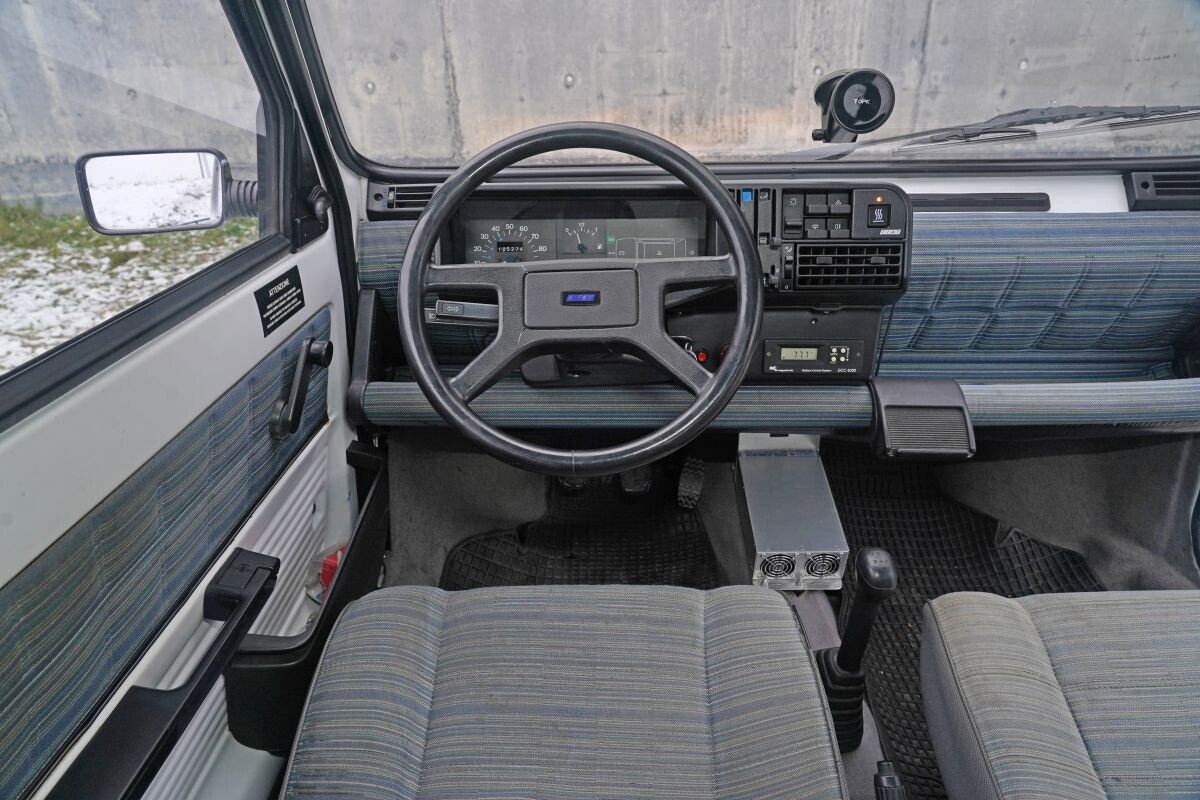
Comfort is secondary in the veteran. Bare sheet metal all around, simple seats that offer little support, the legendary dashboard that, apart from the simple instrument cluster, is a large ball pit. That’s how much storage space there is. The steering wheel is a bit flat because the column pierces the bulkhead at a low point. The driving position suffers somewhat from this. Furthermore, just a gear stick and three pedals. The rear seat is back in this Panda, thanks to the more compact new batteries.
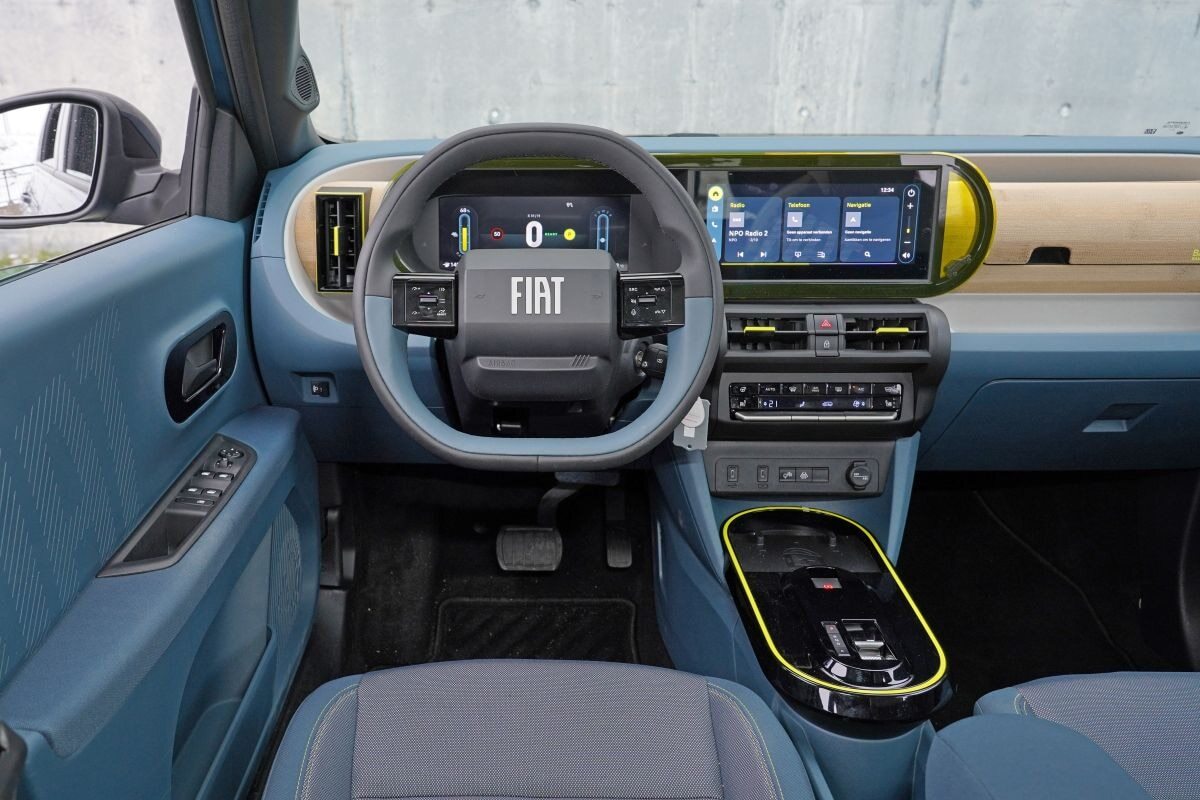
In today’s Panda, it’s all about design. Every detail has been extensively discussed. For example, the large, historically responsible word ‘Fiat’ prominently returns on the steering wheel’s horn plate. The dashboard is tastefully blue, with yellow accents and the somewhat childish Bamboo box. Touches of nostalgia come from the rounded dashboard bezel, the instrument cluster and its typography, around the automatic gear buttons, and the plastic around the door handles: they have the shape of the test track on top of Lingotto. At least, that’s what Fiat wants us to believe. Also, notice the original little Panda starting a loop in the top right corner.
Missing consumption meter
We find the bold ‘FIAT’ letters in the door panels original. Assistance systems are, of course, part of the standard equipment, although adaptive cruise control is not even available. Speed and charging/battery status are naturally displayed digitally, and a central screen on the dashboard informs you about all main and minor issues. However, a consumption indicator is missing. An incomprehensible philosophy, because the GP-E isn’t *that* economical either. Fortunately, basic functions like ventilation and heating buttons are controlled with a knob, but the volume is again adjusted via an ergonomically awkward vertical swipe gesture all the way to the right.
Compared to the original model, the Grande Panda offers comfort and more space, although this is partly negated by thick door panels. Moreover, the black headliner makes the whole thing a bit claustrophobic. We expected a higher level of seating comfort. Space in the back is cramped. Getting in is no longer a feat of strength thanks to the presence of four doors. Finally, the charging cable phenomenon. In the archaic Panda, a long cable lies in the luggage compartment and is connected to the mains. The Grande Panda houses a clever discovery. The coiled cable is located behind what used to be the grille. Now that’s a flap behind the Fiat logo. Be aware that charging takes twice as long as with the regular cable you connect to the flap on the front left. Charging generally takes a very long time anyway.
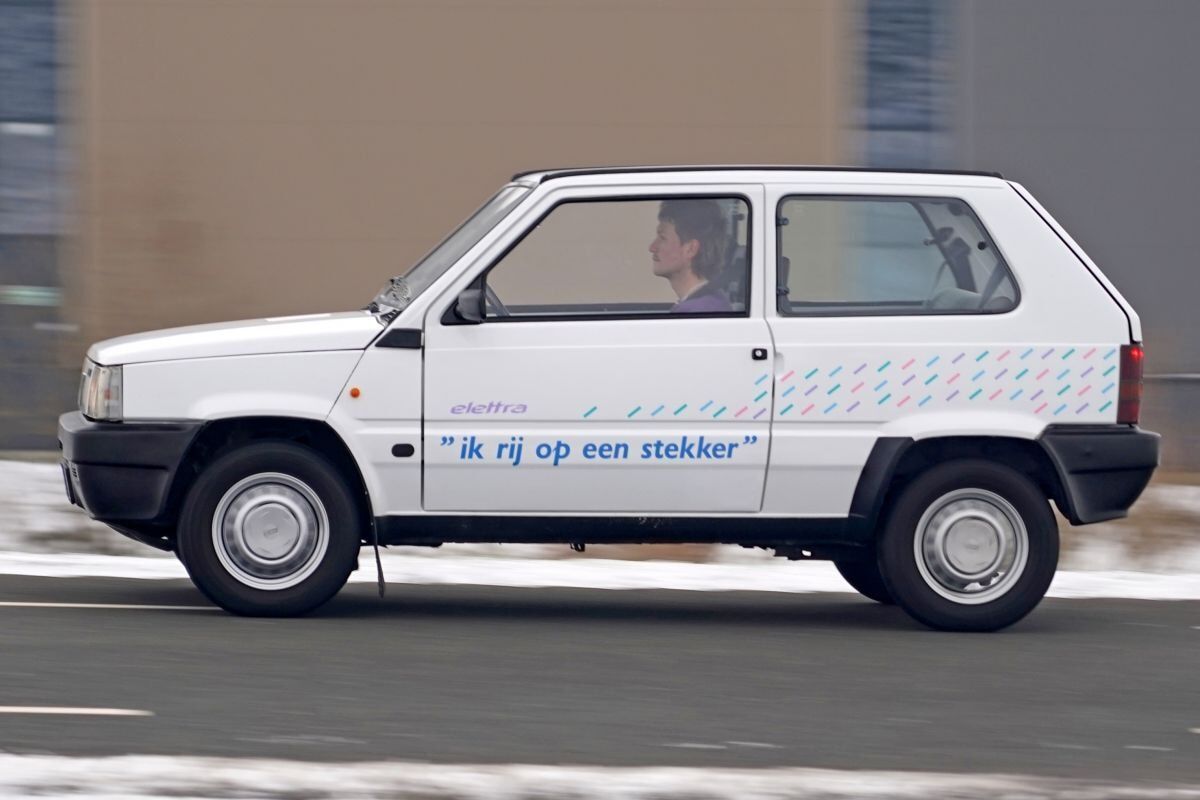
In the old electric Panda, you have to shift yourself
The driving experience in the namesakes differs enormously. First with the 35 year old. To my surprise, Steyr Daimler Puch left the gearbox untouched. So you can simply shift using the regular clutch. “And even into fifth gear,” Gonard adds. “Wijnand replaced the original four-speed gearbox with a five-speed one. You usually start in third gear. The electric motor delivers so much torque that the wheels threaten to slip in the two lower gears. To enable the higher top speed, fifth gear is indispensable.”
According to Gonard, it’s very enjoyable to clutch and shift. “Take your time,” he warns. “The electric motor needs to adjust its RPM, and to spare it, you have to count to 21 or 22 while shifting.” The acceleration is accompanied by the typical sound of a DC electric motor. This improved Panda Elettra delivers 19 hp, while the first version only promised 14 hp. The latest edition has the same number of kilograms to move but has a 113 hp synchronous motor powered by a 44-kWh battery, coupled to an automatic transmission. That’s real progress, even though the Fiat cannot even be called the benchmark.
Elettra not as nimble as a normal original Panda
Expect hardly any driving comfort in the old Panda, although in this electric guise, you can’t possibly compare it to the gasoline version. The vehicle mass literally leaves its mark. The bouncy, playful nature of the regular Panda has given way to a clumsy, yet very comfortable suspension character. In short turns, it prefers to go straight. You feel the mass wanting to go straight while you crank the unassisted steering. The Grande Panda feels light-footed, despite its basic weight of 1,410 kilograms. Brakes and the very direct, too-numb steering are, of course, power-assisted, as if you’re driving a lightweight. Although the tall build throws a wrench in the works by being a bit top-heavy. Moreover, it rides a bit bumpy. In both old and new, the amount of tire noise is noticeable. No surprise in the old one, but it is in the otherwise excellently insulated new one.
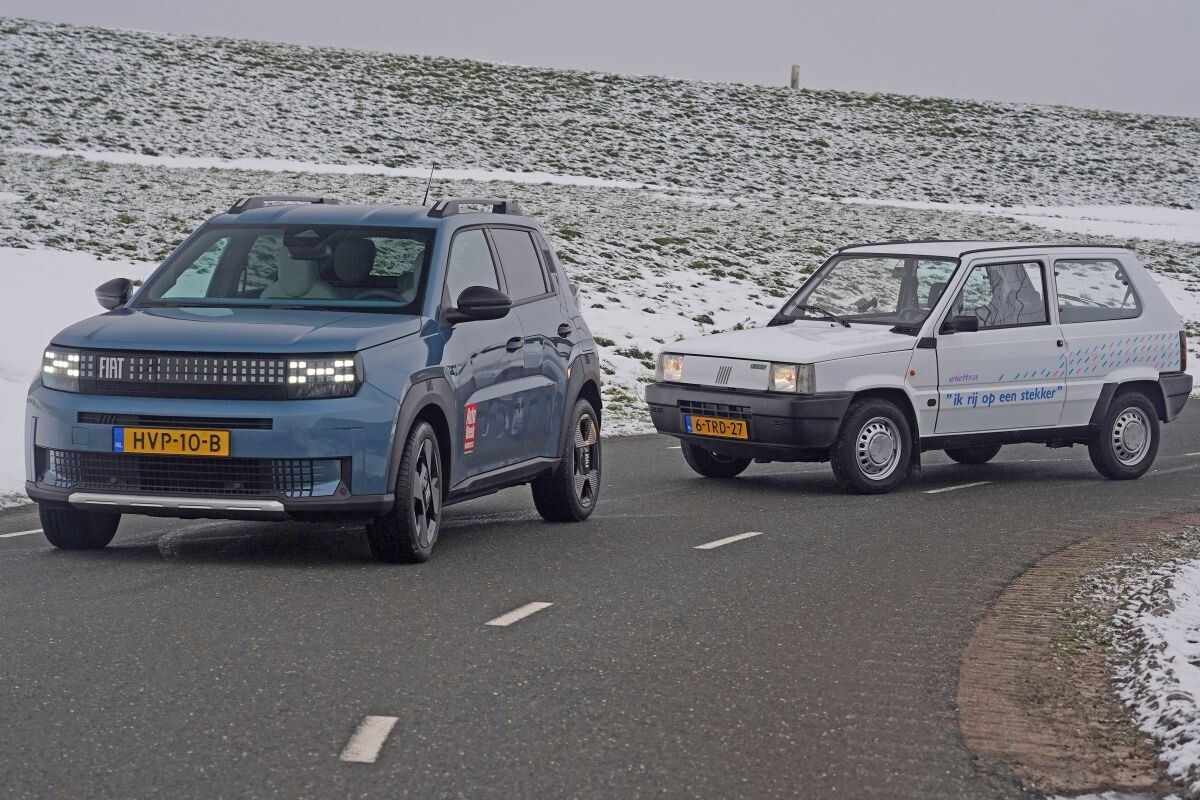
Photography on an icy cold day
The photography takes place on an icy cold Sunday. Strong winds and sub-zero temperatures do not benefit the range. We see the possible kilometers to be driven vanish into thin air. Amsterdam – Nieuwegein suddenly feels very far. While we also want to drive around the photo location and still have to go home. Consider this: upon departure, the range is 290 kilometers, at the destination, 140 of those have already been consumed. That means fast charging during the interview. That process is interrupted at 77 percent. And the seniors? It only has to cruise near its abode, but it quickly falls behind.
Old one still in daily use
Does the Grande Panda live up to its electric qualities? In an endurance test report that we will present to you next week in this spot, you will read that it is especially in its element in urban areas. A family visit far away needs to be planned, with an intermediate stop at a charging station. Meanwhile, Gonard commutes daily to Arnhem and back. “At a speed of 100 km/h, I arrive at my internship address. There are working charging stations there, so I am always assured of returning.”
Technical specifications:
Fiat Panda Elettra
Engine: DC electric motor
Drive: front, 4-speed (from 1992: 5-speed)
Dimensions (L x W x H) 3.04 x 1.49 x 1.42 m
Production 1990-1998: a few hundred
Fiat Grande Panda E 44 kWh 2026
Brakes f/r: ventilated discs/discs
Dimensions (L x W x H) 3.99 x 1.76 x 1.45 m
Power consumption: 17.4 kWh/100 km
Pleasant Panda facts
The first version of the electric Panda had lead-acid batteries. The improved version, the Panda Elettra 2 – available from 1992 – received nickel-cadmium batteries. Power increased from 19 to 26 hp. The four-speed gearbox also made way for a five-speed gearbox.
The Panda Elettra costs no less than three times as much as a Panda Young. Converted, about 25,000 guilders.
The Panda Elettra received a commercial vehicle registration in the Netherlands. This saved special consumption tax (bvb, the predecessor of bpm), because the rear seat was missing.
Although the Panda Elettra disappeared from price lists only in 1998, it was anything but a commercial success. Reportedly, a few hundred were built.
Normally, the fuel tank makes way for a battery pack. Not with the Panda Elettra: the tank serves for heating by an extra heater.
The Grande Panda rolls off the production line in Serbia. Fiat is considering selling it worldwide.
The Grande Panda is available with three types of powertrain: mild-hybrid, plug-in hybrid, and electric.
The first award is in: the Grande Panda recently won the Red Dot Award in the ‘Product Design’ category for its distinctive innovative exterior and interior design. RDDA has existed since 1955.