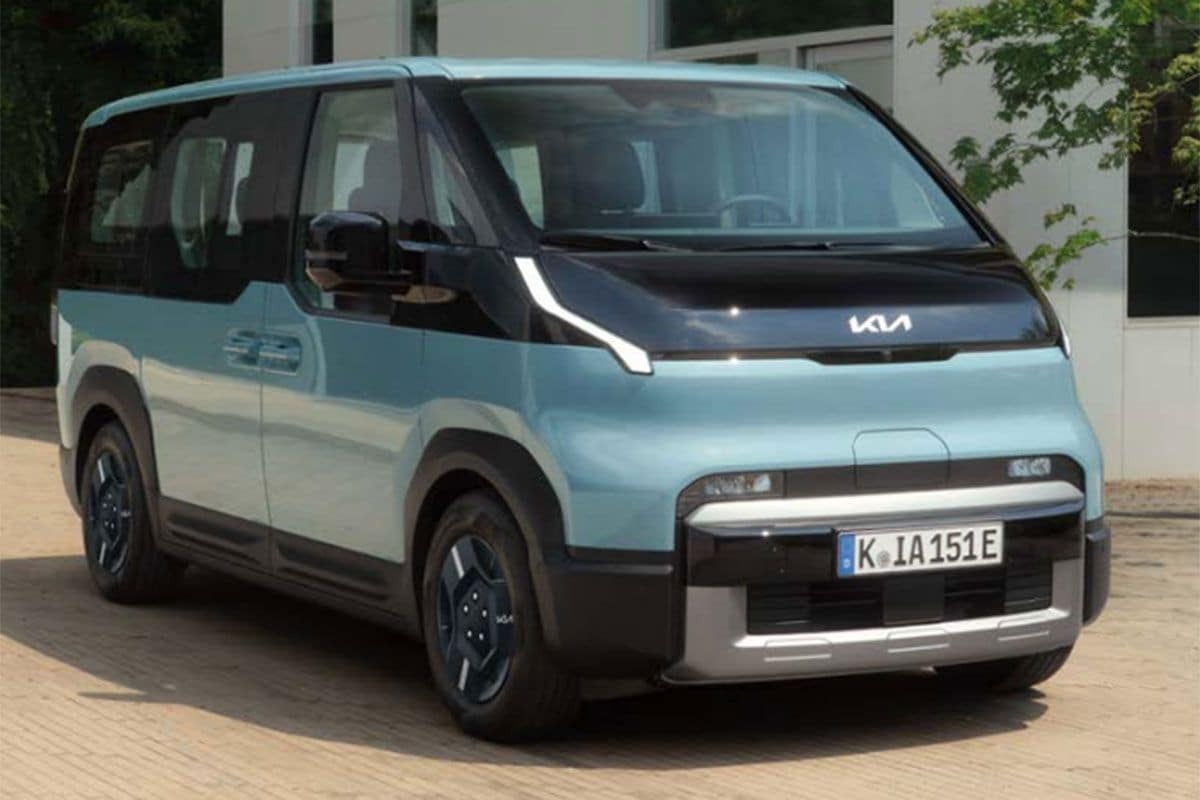
With the Kia PV5, Kia introduces a direct competitor to the Volkswagen ID.Buzz, except that the Kia is considerably cheaper. For less than 39 thousand euros, you get an enormous amount of space, although it is wise to save up a bit more.
Kia PV5 51.5 kWh Essential – €38,895
The MPV is dead, but that doesn’t mean there are no longer any ways to acquire an enormously spacious car. Electric powertrains make it possible to combine a seriously large ‘van’ or SUV with 0 grams of CO2 emissions and thus little BPM (Dutch purchase tax), whereas such a car would have been completely unviable as a passenger vehicle in the Netherlands in the past. Kia already benefited from this with the EV9, but the PV5 Passenger offers even more space for your money. Like the Volkswagen ID.Buzz, the PV5 Passenger is the passenger car version of an always fully electric commercial vehicle.
It really looks like a van, but a very modern one. You can certainly be seen in it. As a private individual, you can drive such a PV5 starting from €38,755 (including VAT) and for that money, you won’t find this much space anywhere else. An ID Buzz is over €10,000 more expensive, and SUV alternatives are all individually more cramped. The cargo space behind the rear seat measures no less than 1,320 liters. This immediately reveals the PV5’s main (temporary) drawback: for now, it is always a five-seater. Kia may have looked a bit too closely at the ID Buzz and will only introduce a version with a third row of seats at a later stage, which in our opinion is absolutely worth waiting for. Only then will you truly benefit from that gigantic amount of space, so with all prices in this story, already factor in a small extra investment for the extra seats that should become available sometime this year.
The PV5 has another major drawback, and that is the battery capacity. For that €38,895, you get a van with 51.5 kWh, which on paper only gets you 295 kilometers. In practice, asphalt often proves to be a lot ‘stickier’, and undoubtedly even less will remain. The PV5 is also available with a 71.2-kWh battery, and although that is still not excessive, the PV5 in that form and with a theoretical range of 412 is much more usable. The ‘Long Range’ also immediately gets some extra power and with its 163 hp, is clearly faster than the 121 hp strong base version. So, just go for the larger battery, although you will then pay at least €42,895 for a PV5 in Essential trim.
The Essential is the cheapest of four equipment levels. These are, in order, the Essential, Plus, Elite, and Elite Executive, with the most expensive version costing €49,145. Still not bad, in fact. On the outside, the Essential is barely distinguishable from a Plus, although the latter has a small sliding window in the sliding door and the Essential does not. The Elite is a little easier to spot thanks to its LED turn signals, and only from the Elite Executive do you get 16-inch alloy wheels as standard. Other versions come with 16-inch steel wheels with hubcaps.
Dacia also calls its basic versions ‘Essential’, but Kia apparently finds a lot more essential than Dacia does. The PV5 always has adaptive cruise control, a rain sensor, dual-zone climate control, parking sensors all around, a reversing camera, and a 12.9-inch touchscreen with navigation. The seats are also ‘just’ standard height-adjustable, and the driver gets their own central armrest for extra comfort.
Nevertheless, the step up to the Plus is worth considering. For exactly €1,000 more, that variant offers the aforementioned sliding windows, but also seat heating, steering wheel heating, a heated windshield washer, a wireless phone charger, a luggage compartment cover, and V2L functionality for charging external devices.