Jeep has its first Compass, developed under Stellantis’ wings, ready in the starting blocks. For a first introduction, we took the e-Hybrid out for a drive, hoping it would distinguish itself sufficiently from its stablemates to proudly wear its own logo.
The Jeep brand, or rather Willys, contributed significantly to the American successes in World War II 86 years ago. True American pride, but, let’s not let Trump hear it, now that same Jeep prides itself on the fact that the new Compass is not only built in Europe but also designed and developed here. The latter is, of course, not so strange, because as a member of the Stellantis clan, the new generation Compass gets the STLA Medium platform.
Where does the Jeep Compass come from again?
The Jeep Compass first saw the light of day in the early weeks of 2006, then, of course, still in Detroit. Back then, long before the Avenger, it was still ‘the small Jeep’ and it stood on the platform of the Dodge Caliber. Despite its modest position in the Jeep pecking order, it had permanent four-wheel drive and low gearing. In 2011, the car was facelifted to make way for the Compass 2 at the end of 2016, which replaced not only its predecessor but also the Patriot. The Compass 2 got a refreshed face in 2021, and now that is also due for replacement. At the beginning of this year, during the driving impression of the new Avenger, we were already able to take a brief look at the Compass 3, now the time has finally come: we can take the wheel.
How do you turn a Stellantis car into a real Jeep?
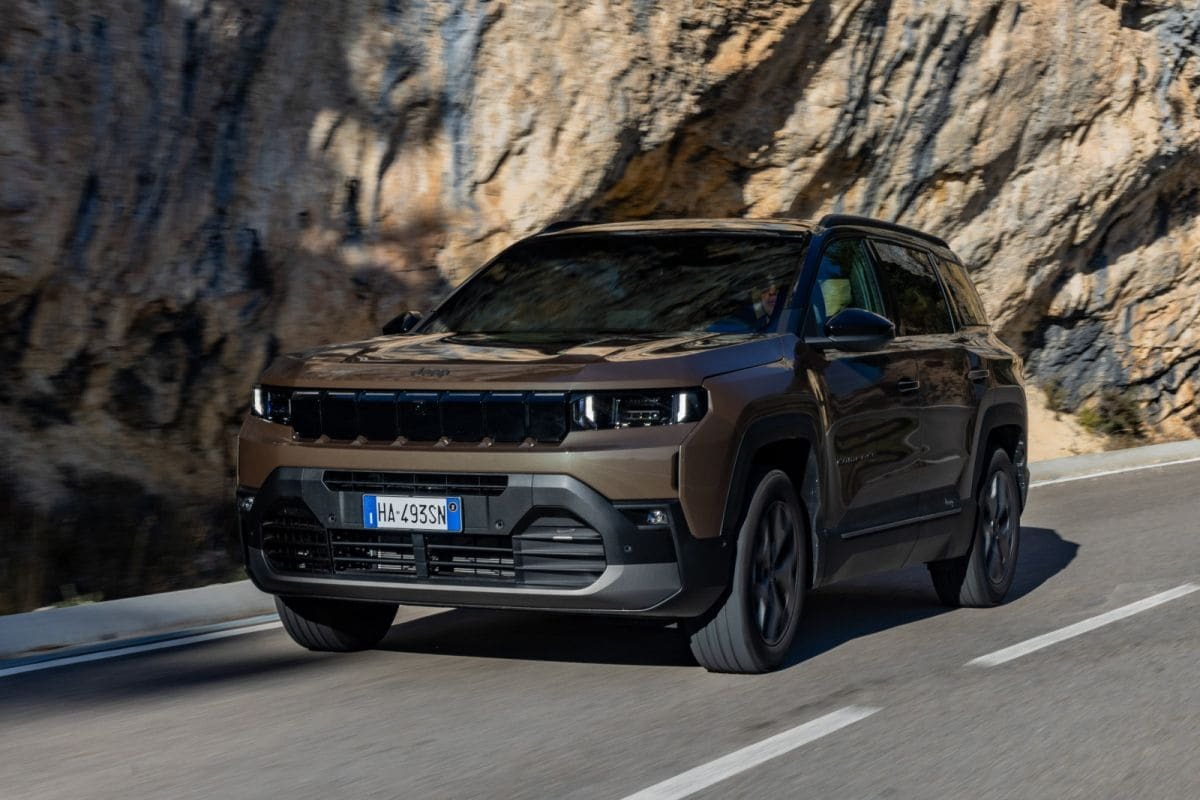
Jeep has now been part of the Stellantis concern for just under five years, and the new Compass is, of course, based on Stellantis technology. This makes it technically very closely related to the Peugeot 3008, Citroën C5 Aircross, and Opel Grandland, among others. Perhaps that is why Jeep has pulled out all the stops to differentiate itself. The seven angular segments in the nose make the Compass look like a real Jeep. It is the traditional reference to the seven vertical slots that provided cooling for the Willys on the battlefields. They are flanked by fairly flat headlights, making the Compass seem to look at the world with a squint. Thanks to thick black edges, the angular wheel arches give the impression of being even larger, and at the rear, the striking taillights, which are supposed to depict the cross pattern on jerry cans, are connected by a light bar with the brand name in the middle, illuminated. Robust-looking bumpers and side skirts should make you forget that this Jeep only has front-wheel drive. For good measure: Jeep has done more to prevent this car from dragging Jeep’s history through the mud, but more on that later.
It has grown? How so?
For those who already drive a Compass: the new one has become a lot bigger, not only on the outside but also on the inside. The wheelbase has grown by fifteen centimeters, and the same applies to the body in length. Furthermore, the Compass became two centimeters wider and stands five centimeters closer to the clouds. Big win for the occupants, because it is nice and spacious. In the back, you sit comfortably and you don’t have to be petty about luggage à la Transavia. The trunk has grown by 45 liters and now measures 550 liters.
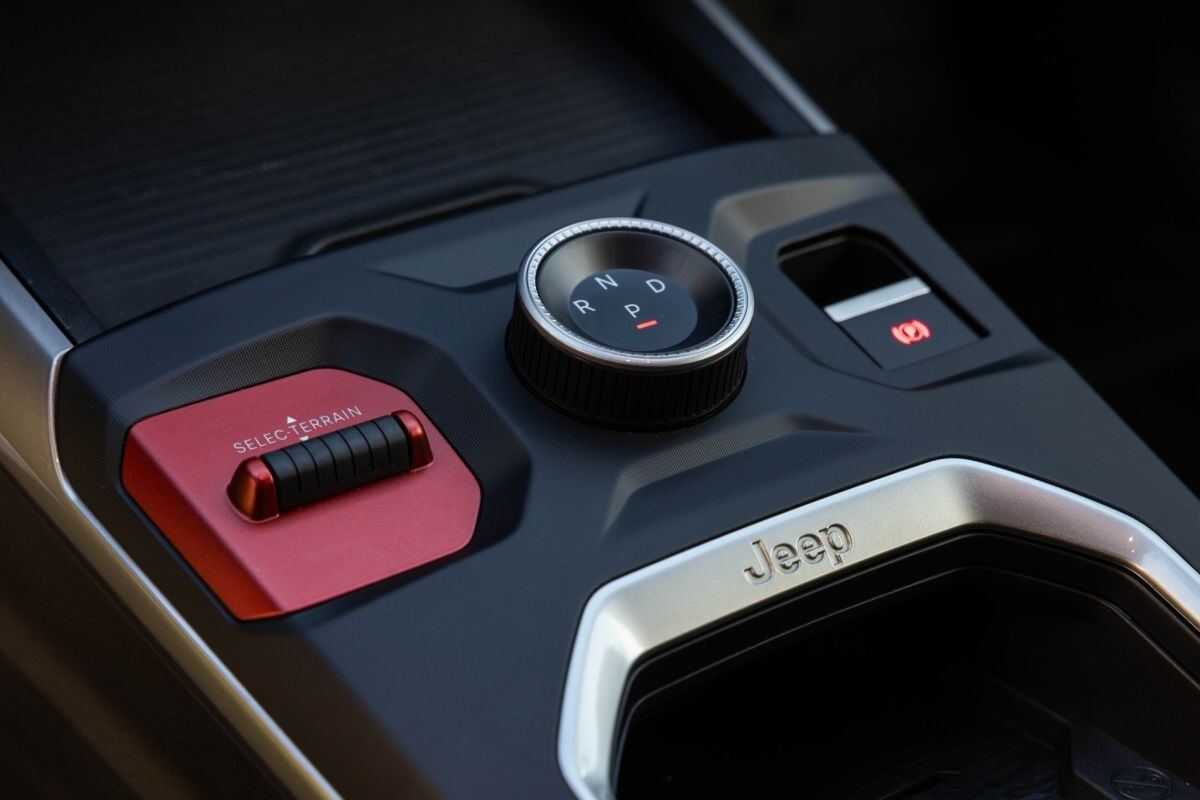
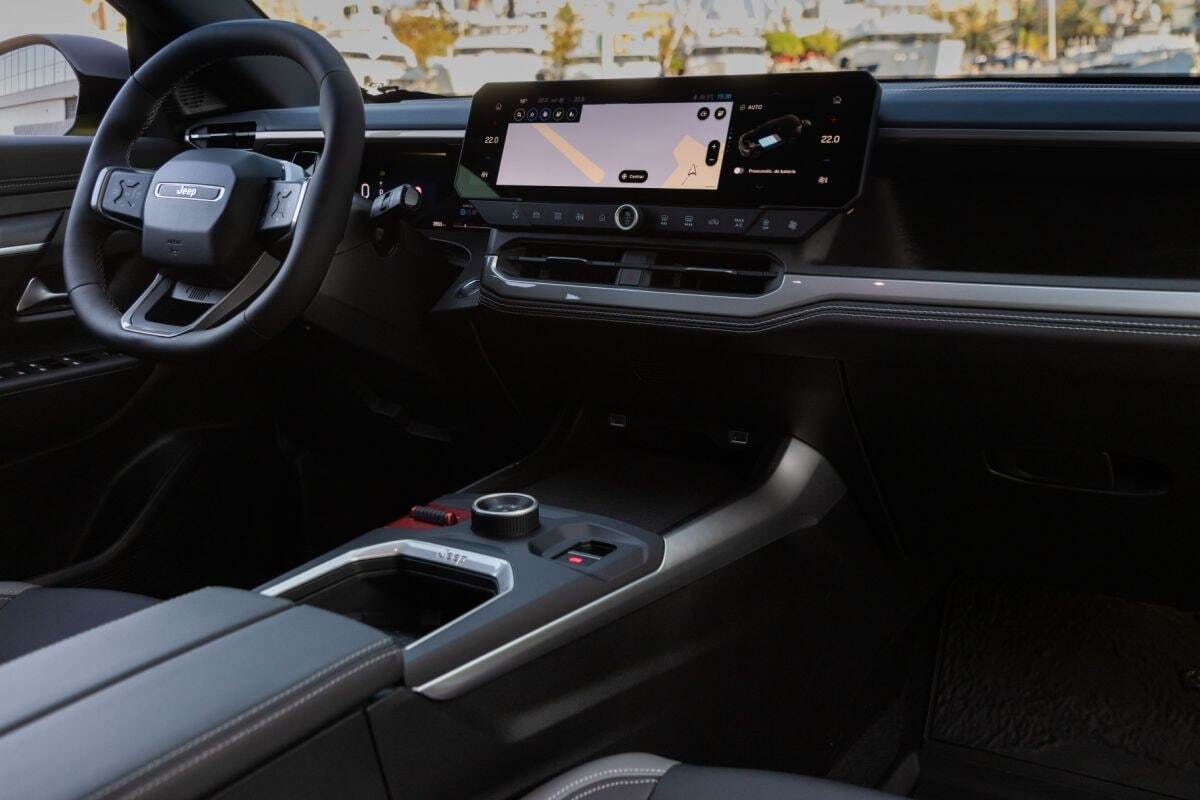
You also sit comfortably in the front. The small, flattened steering wheel feels good in the hand and is full of physical buttons that relieve the dashboard, so that it remains calm there. It is therefore clearly arranged and looks beautiful, but a bit conservative. Also, the materials here and there come across as a bit cheap. This does not apply to the rotary knob of the transmission and, to the left of it, the selector switch of the driving modes. They are easy to operate and feel robust.
Can you also do Jeep things with the Jeep Compass?
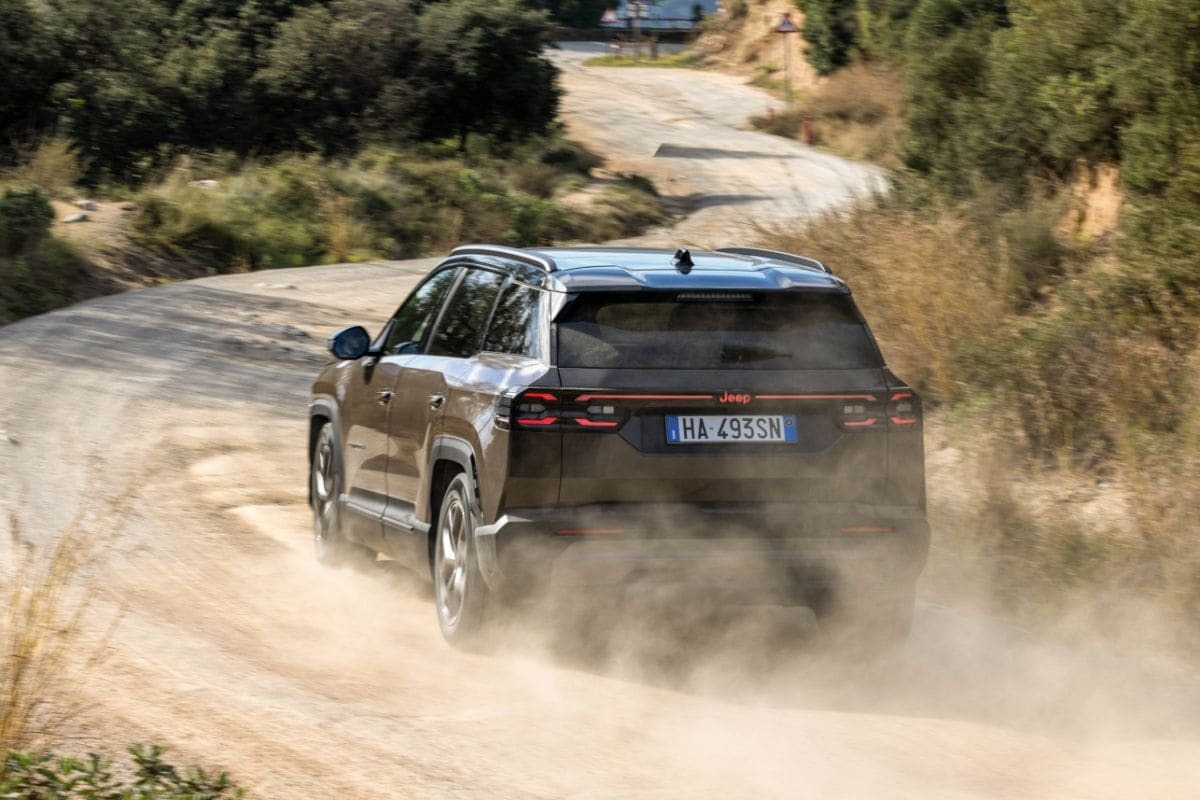
To make the Compass the scout compared to its braver cousins, Jeep has raised it to twenty centimeters of ground clearance. In addition, it has an approach angle of twenty degrees, a departure angle of 26 degrees, and a wading depth of 47 centimeters. That is nice, but in practice, we notice that you get wheelspin very quickly on loose surfaces, even without a slope. You can control that somewhat with Selec Terrain. The system controls the power delivery, shifting, steering, ESP, and ADAS. By default, it is in Auto and then you get a maximum of ninety percent power. In Sport you get the full load and, if necessary, some overboost. Moreover, steering, ESP, and automatic transmission are then sportier. Snow mode limits the power to eighty percent, sharpens the steering, and optimizes ESP, and for non-winter terrain conditions you have Mud/Sand, where you can release the full load of power on the wild surface again. Finally, there is an Electric mode on the plug-in hybrid, with which you can drive the car as an EV (as long as the supply of electricity lasts).
How does the Compass drive on asphalt?
Jeep says it has seasoned the STLA Medium platform to its own taste and we get the impression that these are not empty words. The Compass feels quite tight and even a bit sporty, especially for a car that should have some off-road capabilities. The steering is reasonably direct and precise, even in Auto, while the body rolls little in fast corners. However, understeer is then lurking. Despite the fairly firm chassis, the car knows how to absorb bumps well. The six-speed dual-clutch automatic transmission does its job virtually unnoticed. This does not apply to the engine, because when you ask a lot of it, the small three-cylinder roars it raw. The improved sound insulation that Jeep says to have applied to the new Compass is not (sufficiently) up to that. The Compass has standard level two autonomy, where the adaptive cruise control is ‘predictive’. That means it adjusts the speed in case of approaching roundabouts, bends, and speed limits. Jeep’s infotainment system has been kept up to date for ten years at no extra cost and those who want to try the more extensive version, Connect Plus, get it on trial for free for the first year. Then you have a permanent passenger and co-pilot in Chat GPT, you can open the car with your smartphone and you have interactive navigation.
When will the Jeep Compass come to our country?
The adventure of the Jeep Compass starts in the Dutch showrooms in February 2026 with this 1.2 e-Hybrid with 145 hp, and the lightest full EV with 213 hp. Both are front wheel drive. Later there will also be a plug-in hybrid with 195 hp. Finally, there are two more powerful EVs in the pipeline. A 230 hp strong front-wheel drive and the 4x-e, which thanks to an extra motor on the rear axle is the only 4WD-Compass and puts 375 hp on the four wheels.
“`